
Book Review. Warming updates.
Book Review. Warming updates.
Simon Maxwell
The weather varies from year to year, but the underlying trends are alarming. Two new reports drive home the point.
The State of the European Climate
First, a new report from the Copernicus Climate Change Service, its annual European State of the Climate Report 2025, says that
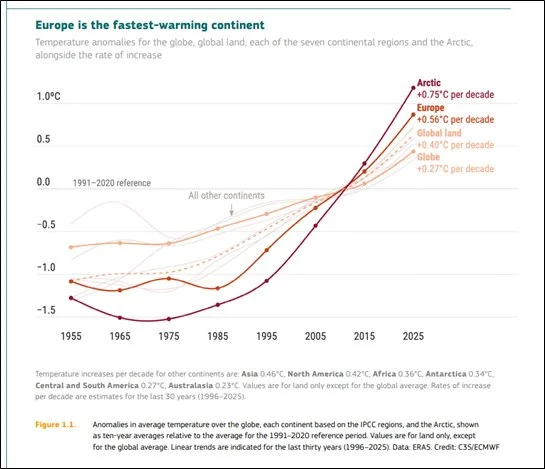
‘Since the 1980s, Europe has been warming twice as fast as the global average, making it the fastest-warming continent on Earth.’
See Figure 1. The Continent has been warming at 0.56 degrees per decade and has now warmed by around 2.5°C compared to pre-industrial levels.
Figure 1
Europe is the fastest warming continent
Source: https://climate.copernicus.eu/sites/default/files/custom-uploads/ESOTC-2025/ESOTC-2025-report.pdf
Why is this? The Copernicus Report cites four main reasons:
Changing weather patterns: Shifts in atmospheric circulation have favoured more frequent and more intense summer heatwaves .
Reduced air pollution: Aerosols can reduce the amount of solar radiation reaching the surface. Since the 1980s, stricter air quality regulations have reduced emissions, and therefore aerosol concentrations, across Europe. Cloud cover is also reduced as pollution decreases.
Decreasing snow cover: As temperatures increase, snow cover across Europe has been declining, reducing the albedo – the amount of solar radiation reflected back into space – and leading to more rapid warming.
Geography: Parts of Europe extend into the Arctic, the fastest-warming region on Earth.
The consequences are visible for all to see. Heatwaves are becoming more frequent and severe. Glaciers in all European regions continue to melt. And changes in precipitation patterns, including an increase in the intensity of the most extreme events, have been observed.
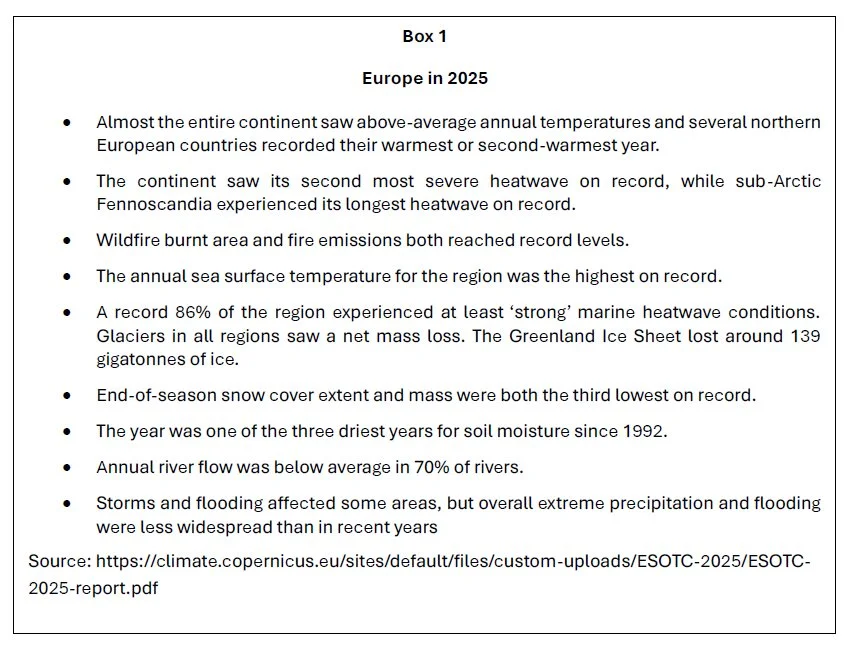
The weather varies from year to year. But events in 2025 illustrated the trend (Box 1).
The UK: our way of life under threat from heat, flooding and drought
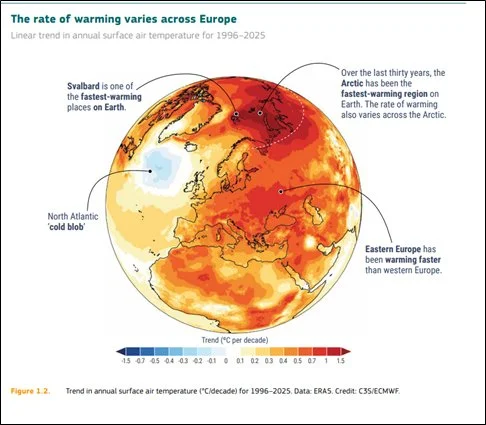
It might be thought that the UK is less severely affected, and indeed the Copernicus data does show that the UK is warming less quickly than Eastern Europe, or, especially, the Arctic (Figure 2).
Figure 2
The rate of warming varies across Europe
Source: https://climate.copernicus.eu/sites/default/files/custom-uploads/ESOTC-2025/ESOTC-2025-report.pdf
Nevertheless, the UK Climate Change Committee has a similar message to Copernicus. It has made the argument strongly in its previous reports, including the annual report to Parliament, most recently in April 2025. Its new report, A Well-Adapted UK, argues that
‘the UK is already experiencing the impacts of changing weather and climate . . . (and this) is undermining the UK’s security and prosperity.’
The press release, looking forward to 2050 and 2100, makes the stronger claim that our ‘way of life is under threat’.
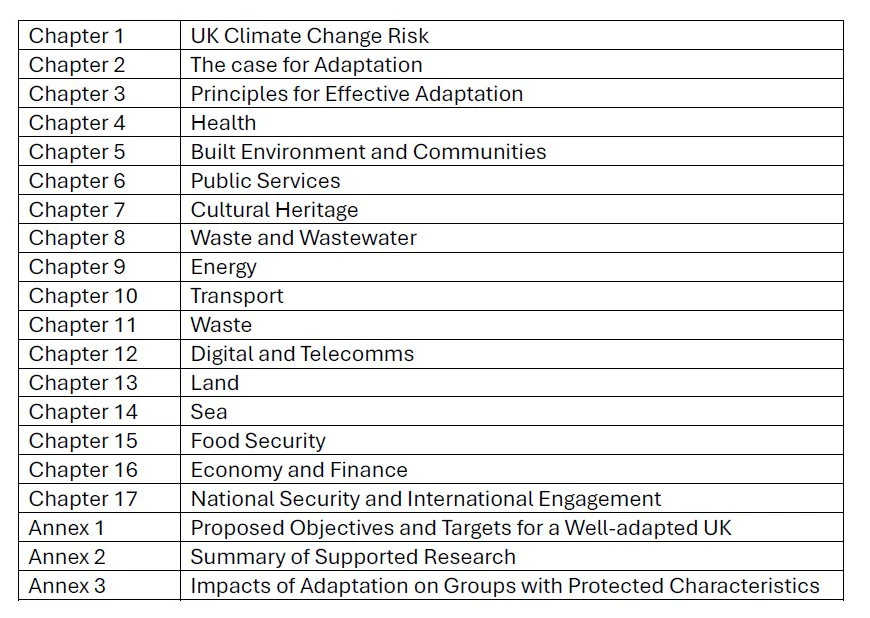
The new report is over 500 pages long. It introduces risk scenarios out to the end of the century, makes the economic case for adaptation, offers 10 principles for effective adaptation, carries out a sector by sector review, and proposes objectives and targets for effective adaptation. The Table of Contents is summarised in Table 1. A more detailed review of the report is in the Climate:Change pipeline.
Table 1
Table of contents of the CCC Adaptation Report
Source: adapted from https://www.theccc.org.uk/wp-content/uploads/2026/05/A-Well-Adapted-UK-CCRA4-IA-784y9813-3094039i85t59yhfufoub24f2bipdj1.pdf
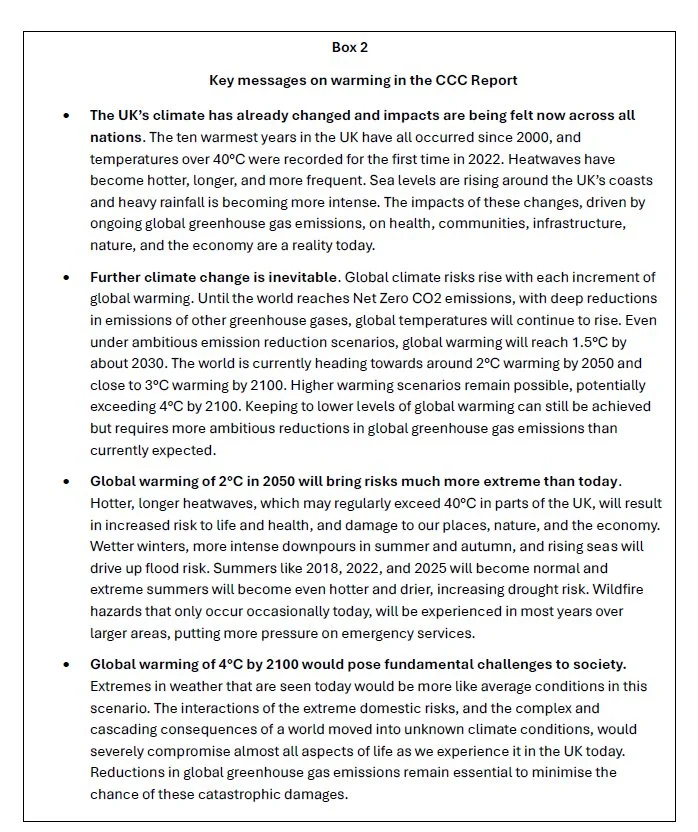
In the meantime, however, and to focus on the analysis of warming and of risk, the CCC Report has four key messages:
The UK’s climate has already changed and impacts are being felt now across all nations.
Further climate change is inevitable.
Global warming of 2°C in 2050 will bring risks much more extreme than today.
Global warming of 4°C by 2100 would pose fundamental challenges to society.
More detail is provided in Box 2. Note the important guiding assumption, that global temperatures will reach 2 degrees by 2050, with the possibility of 4 degrees by 2100.The Report says that 4 degrees by 2100 ‘remains plausible’ and ‘cannot yet be ruled out’. For discussion, perhaps: these are quite aggressive assumptions, especially for 2100.
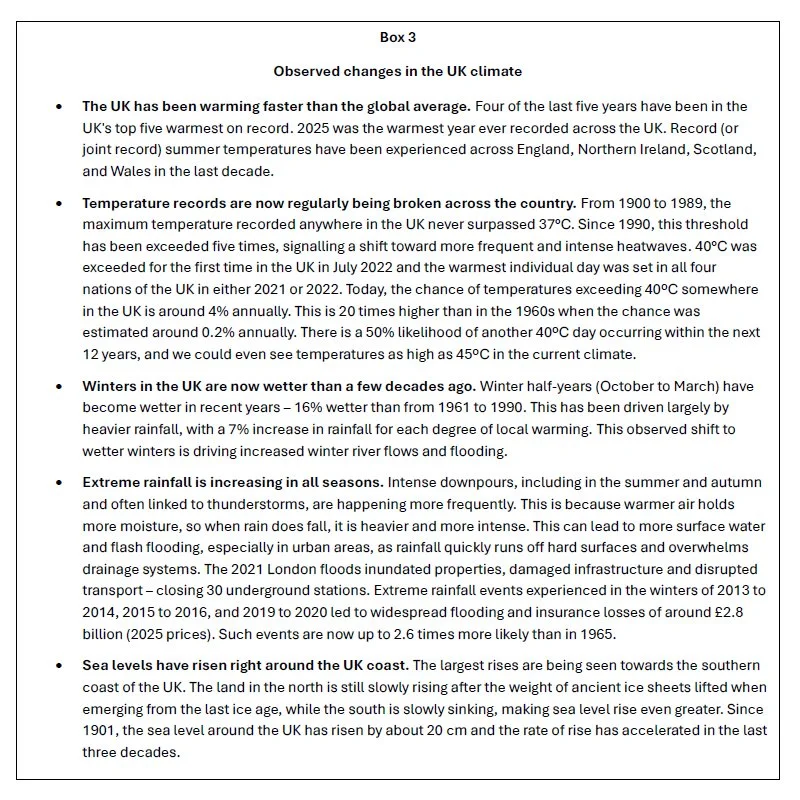
A later section provides more detail on observed changes (Box 3), noting that the UK has been warming faster than the global average, that temperature records are .being broken regularly, that winters are wetter, that sea levels have risen, and, importantly, that extreme events are more frequent. As the Report says,
‘This change in weather . . . will not be felt gradually but instead by sudden instances of record-breaking conditions’.
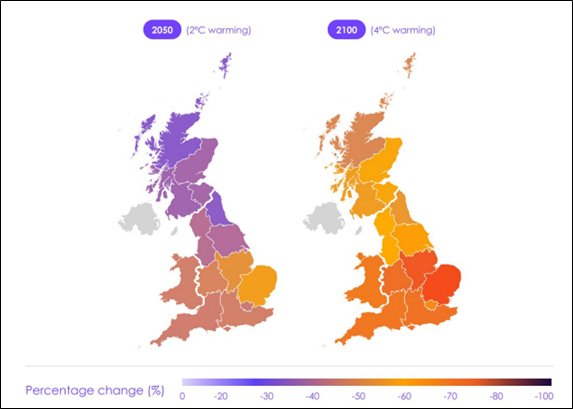
Projecting forward, the Report looks at a range of topics, including maximum temperatures, flooding, and water availability in rivers. These are illustrated graphically, as in Figures 3 and 4.
Figure 3
Recent and Projected National Temperatures
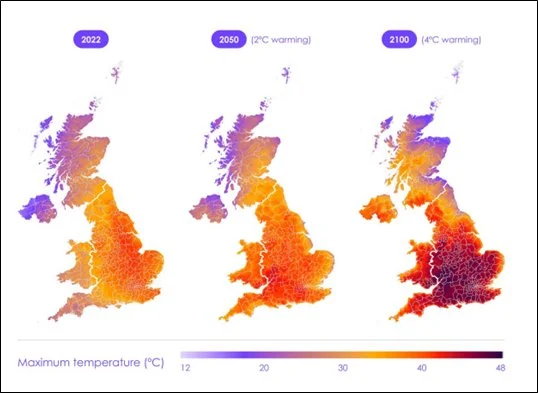
Figure 4
Projected change in water available in rivers during droughts
Before turning to priorities, the Report makes an important contribution to understanding the social and regional dimensions of vulnerability. Key factors influencing this variation
‘include differences in health status, disability, age structure, housing quality, access to cooling or flood-resilient infrastructure, strength of local social networks, and availability of public services.’
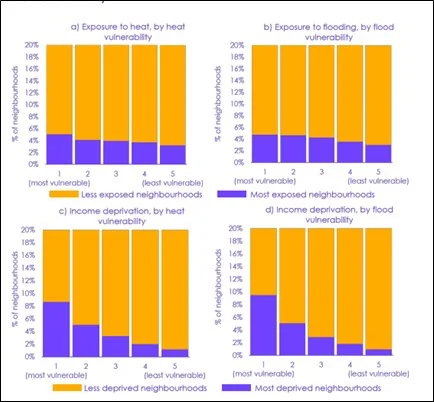
There are sharp differences between neighbourhoods: for example,
‘Neighbourhoods that are more vulnerable to overheating and flooding tend to be more exposed to overheating and flooding than neighbourhoods that are less vulnerable in the UK. However, exposure alone does not reliably identify vulnerability. Vulnerability to overheating and flooding is also closely linked to income deprivation.’
See Figure 5.
Figure 5
The link between exposure, income deprivation, and vulnerability
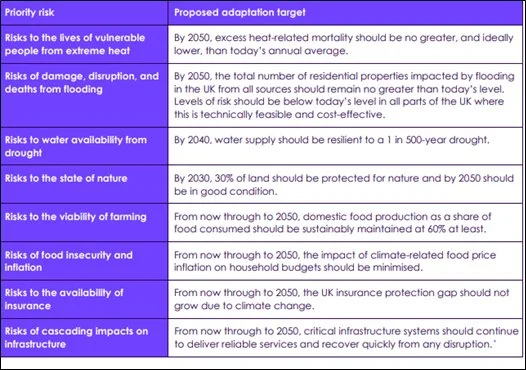
In terms of priority risks, the CCC lists eight, summarised in Figure 6:
Risks to the lives of vulnerable people from extreme heat.
Risks of damage, disruption, and deaths from flooding.
Risks to water availability from drought.
Risks to the state of nature.
Risks to the viability of farming.
Risks of food insecurity and inflation.
Risks to the availability of insurance.
Risks of cascading impacts on infrastructure.
Figure 6
Priority climate risks to the UK
Implications for Brighton and Hove
All these risks are well understood in Brighton and Hove, and have been the subject of analysis and debate by Climate:Change. See, among other things, the authoritative Briefing Paper by Andrew Coleman, his subsequent report on sea warming, the report of our public meeting on adaptation, and Nicky Lumb’s review of the Climate Change Committee Adaptation Report. We have forthcoming work on heat.
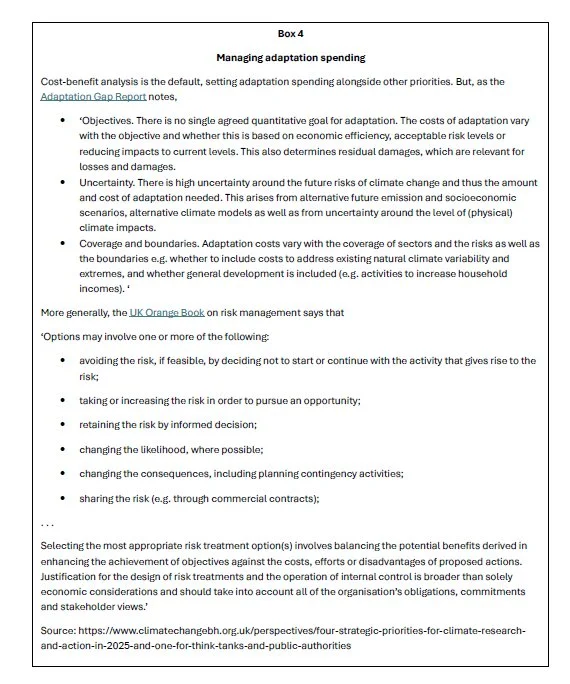
More spending on adaptation in the City will be essential. At the same time, public resources are scarce, and priorities will be hard to decide. As I observed last year, ‘adaptation needs to be assessed alongside other risks, like cybersecurity or vulnerabilities in energy systems’. The national risk register is instructive in this regard. The UK Orange Book on risk management is right to say that the first line of action may be to avoid risk in the first place. See Box 4.
The Climate Change Committee has an analysis of cost-effectiveness in Chapter 2, with a series of benefit-cost ratios for different sectors. It will be interesting to apply this methodology locally.
Simon Maxwell is Co-Chair of Climate:Change
Perspective pieces are the responsibility of the authors, and do not commit Climate:Change in any way.