
Meeting Report. Heat waves. Storms. Flooding. Drought. Is Brighton and Hove ready for climate change?
Report on a public meeting held at the Brighthelm Centre on Monday, 1 December 2025
A public meeting was held on Monday, 1 December 2025, to discuss climate change risks and adaptation issues in the City. About 60 people attended.
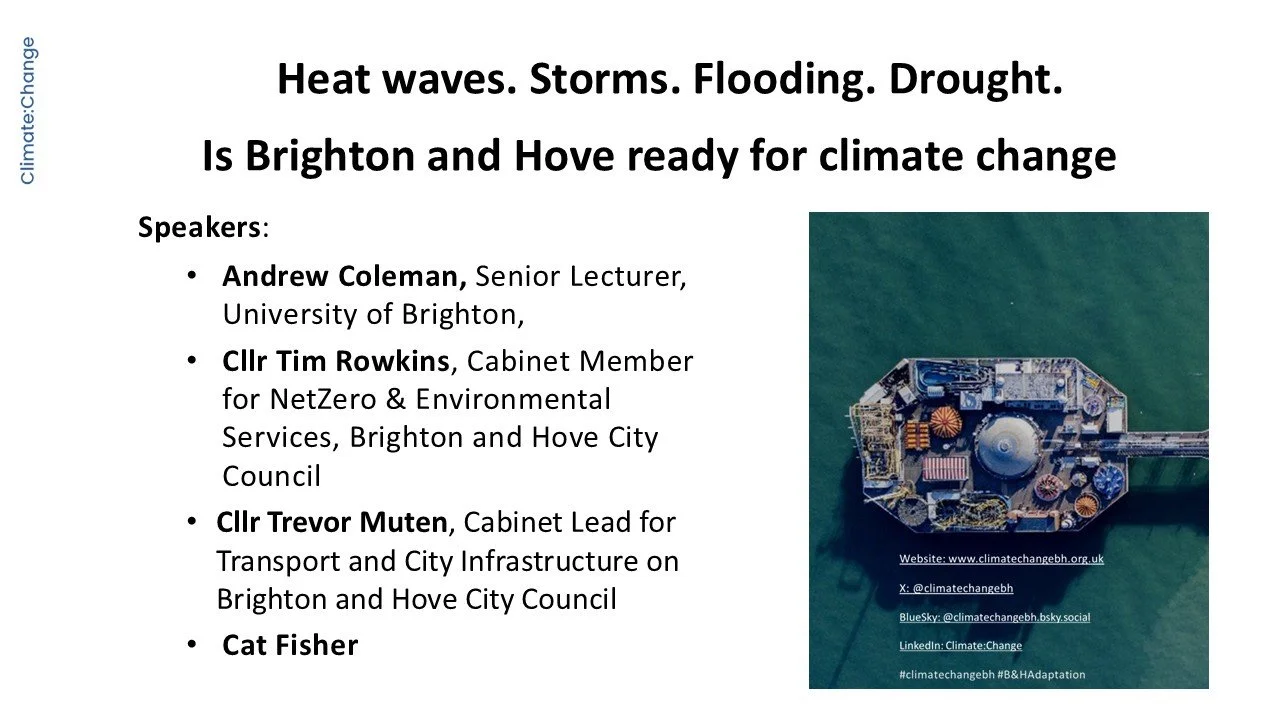
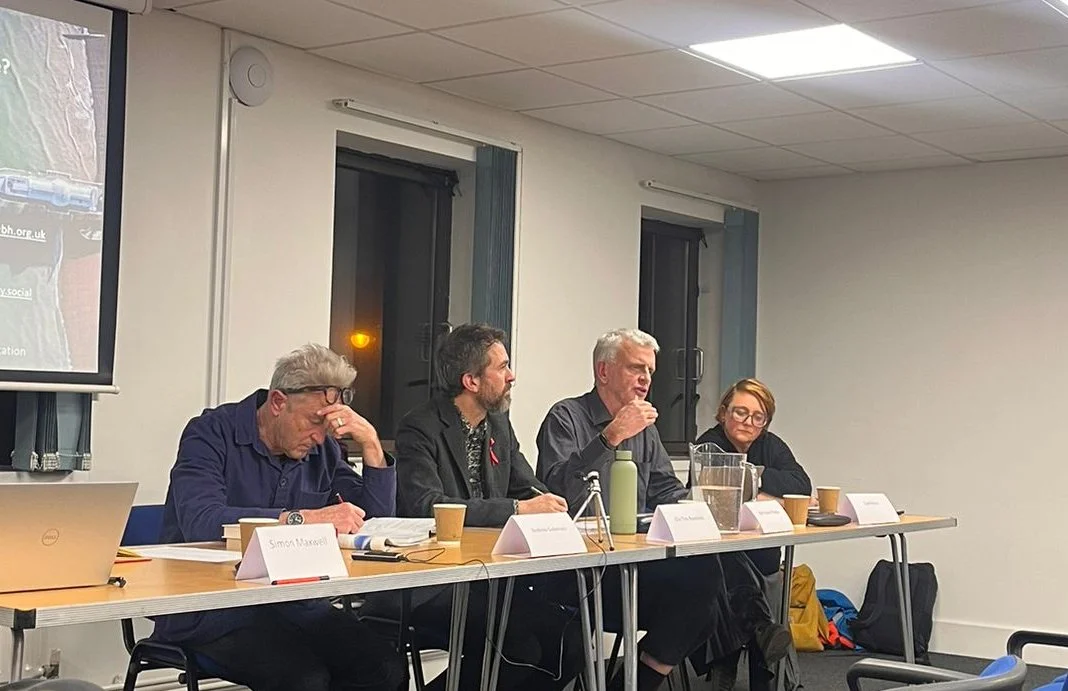
Simon Maxwell introduced the meeting and the speakers (Figure 1). This was a consultative meeting to support the Council as it continued to develop its strategy. A further meeting would take place in the New Year, when plans were complete.
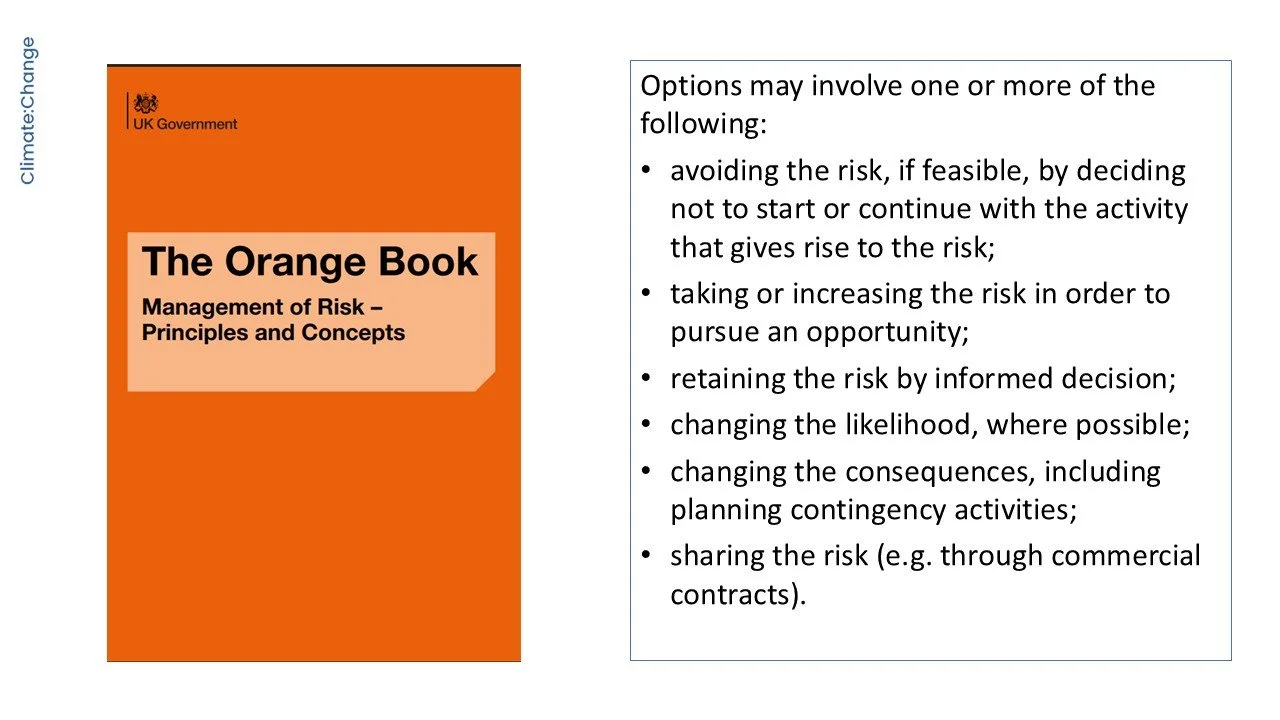
Simon made the point that climate risk is one of many faced by citizens, Councils and the country, alongside , for example, future pandemics, cyber attacks, nuclear accidents or war. The National Risk Register provided a comprehensive overview of the likelihood and impact of different risks, and the Government’s Orange Book set out the criteria for prioritising expenditure. Often, it was important to sidestep risk by not doing things that would increase exposure or vulnerability (Figure 2). Simon’s opening slides can be found as a pdf here. An audio recording is here.
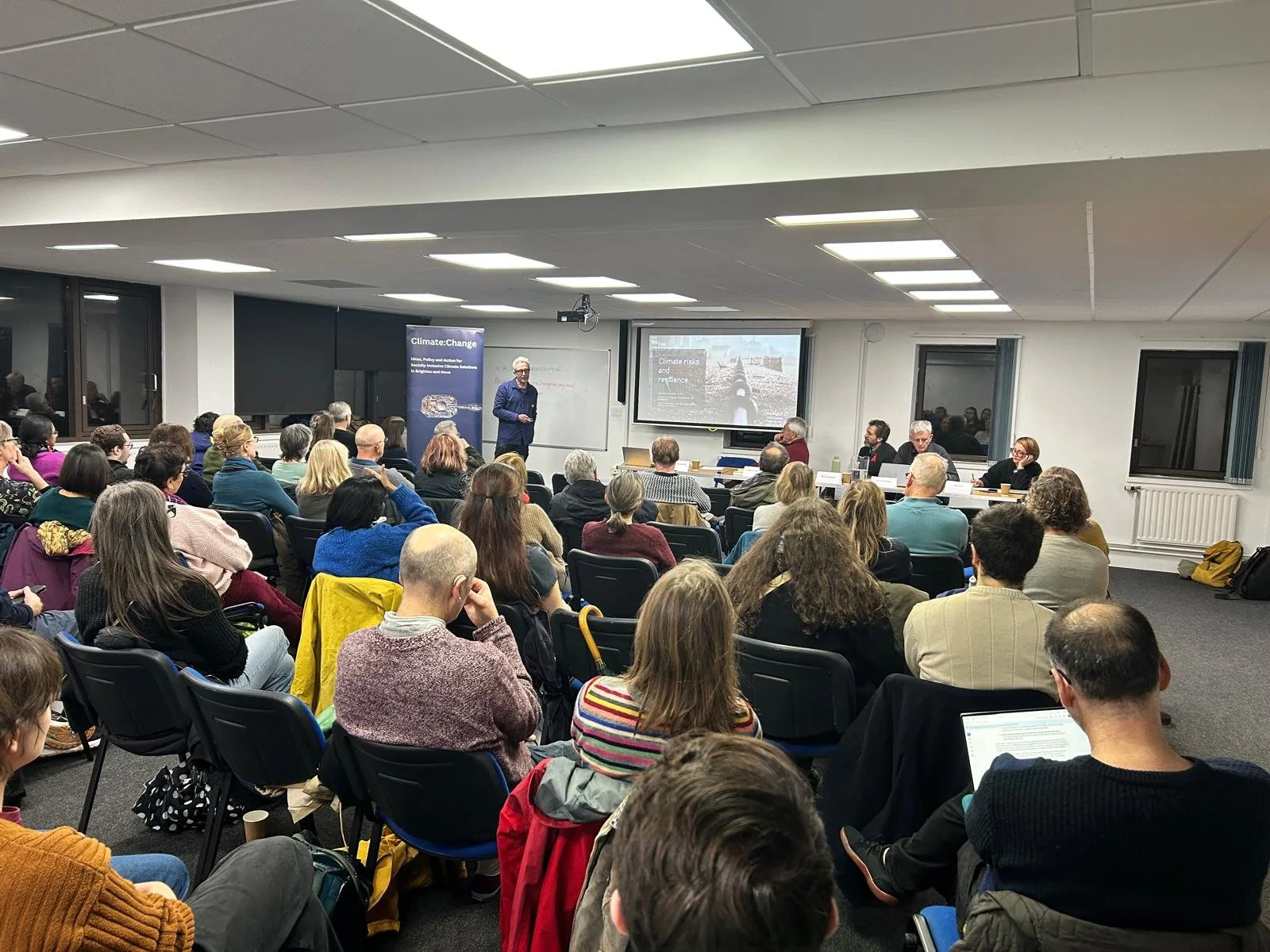
Andrew Coleman gave the main presentation, building on his two Briefing Papers for Climate:Change, the first on the adaptation strategy (here), the second on the impact of warming seas around the City (here). His presentation can be found as a pdf here. Andrew covered: Definitions and concepts; Adaptation at COP 30; UK progress on adaptation; Brighton and Hove’s Risks, Responses, Gaps & Opportunities; individual action; and Resources. An audio recording is here.
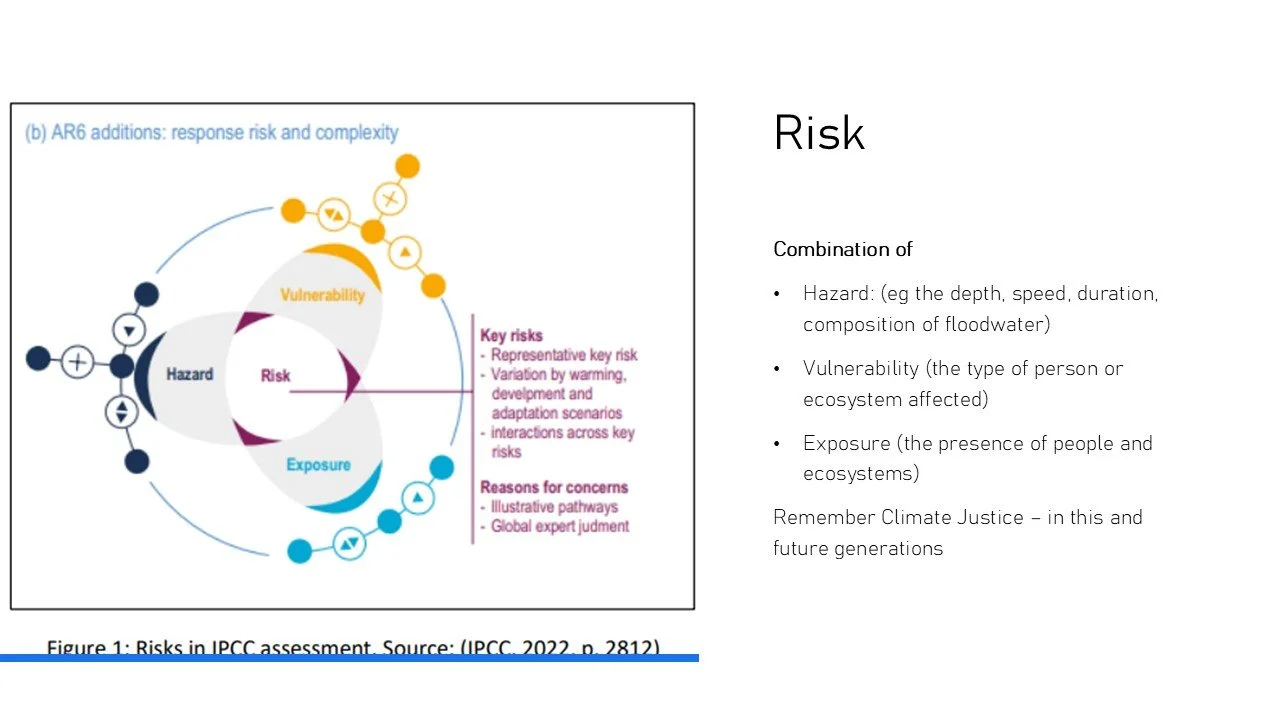
Introducing concepts and the rising profile of adaptation, Andrew discussed the interaction between hazard, vulnerability and exposure. He emphasised the importance of tackling risk with a focus on climate justice (including wrt to inequality, and taking account of future generations), and said it was important to think about adaptation as being ‘transformational’ – ‘bouncing forward’ rather than just protecting the status quo. See Figure 3.
Nationally, progress on adaptation was inadequate, as detailed by the Climate Change Committee, in a report reviewed for Climate:Change by Nicky Lumb (here). In Brighton and Hove, there was also a lot to do. The biggest risks had been identified as heat, water scarcity, flooding, and sea level rise, among others. He summarised findings from research on these topics.
When it came to responses, Andrew covered measures needed, including infrastructural - green and blue infrastructure, sustainable drainage systems, coastal defences, and the like - as well as standards for new buildings, and changes in working practices. Many of these had been listed in the 2023 adaptation study produced for the Council by Arup. There were still many uncertainties about implementation of priority actions, however, and a great need for further consultation. There was much to be learned from local and individual work in this area. He celebrated ‘Climate Heroes’.
Responding to the presentation, Tim Rowkins emphasised that climate change impacts were already being felt, and felt more frequently: the flooding caused by water running down Elm Grove was a notable example, with the ‘procession of bins down a white water rapid’; heat was also a growing problem, despite Brighton and Hove benefiting from being close to the sea and the green spaces of the Downs. Resources were tight, and some interventions were expensive: he cited trees on streets as an example, an especially difficult topic when dealing with ash die back and other diseases absorbed a lot of money. There were other actions underway, including on coastal defences, sustainable drainage, and nature recovery. But some big and expensive improvements to infrastructure would undoubtedly be needed in the future. An audio recording is here.
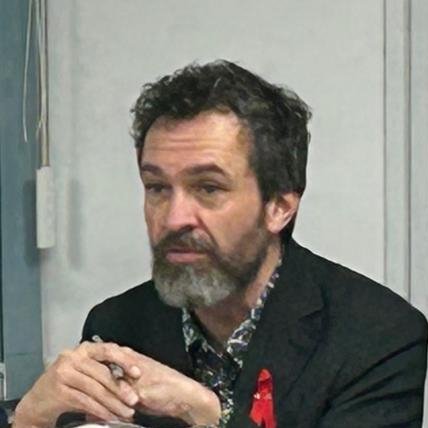
Trevor Muten led for the Council on infrastructure issues, and bought to the task his past experience as a hydrogeologist, including working on trigger points and contingency plans to manage flooding in the Preston area of the City. New partnerhips were needed with Southern Water and with developers. Residents also had a role to play: for example, paving over front gardens could increase run-off if permeability was not built in. The Council was also working intensively on sea defences, especially building groynes to strengthen shingle beach defences against sea level rises and the intensity of storms. An audio recording is here.
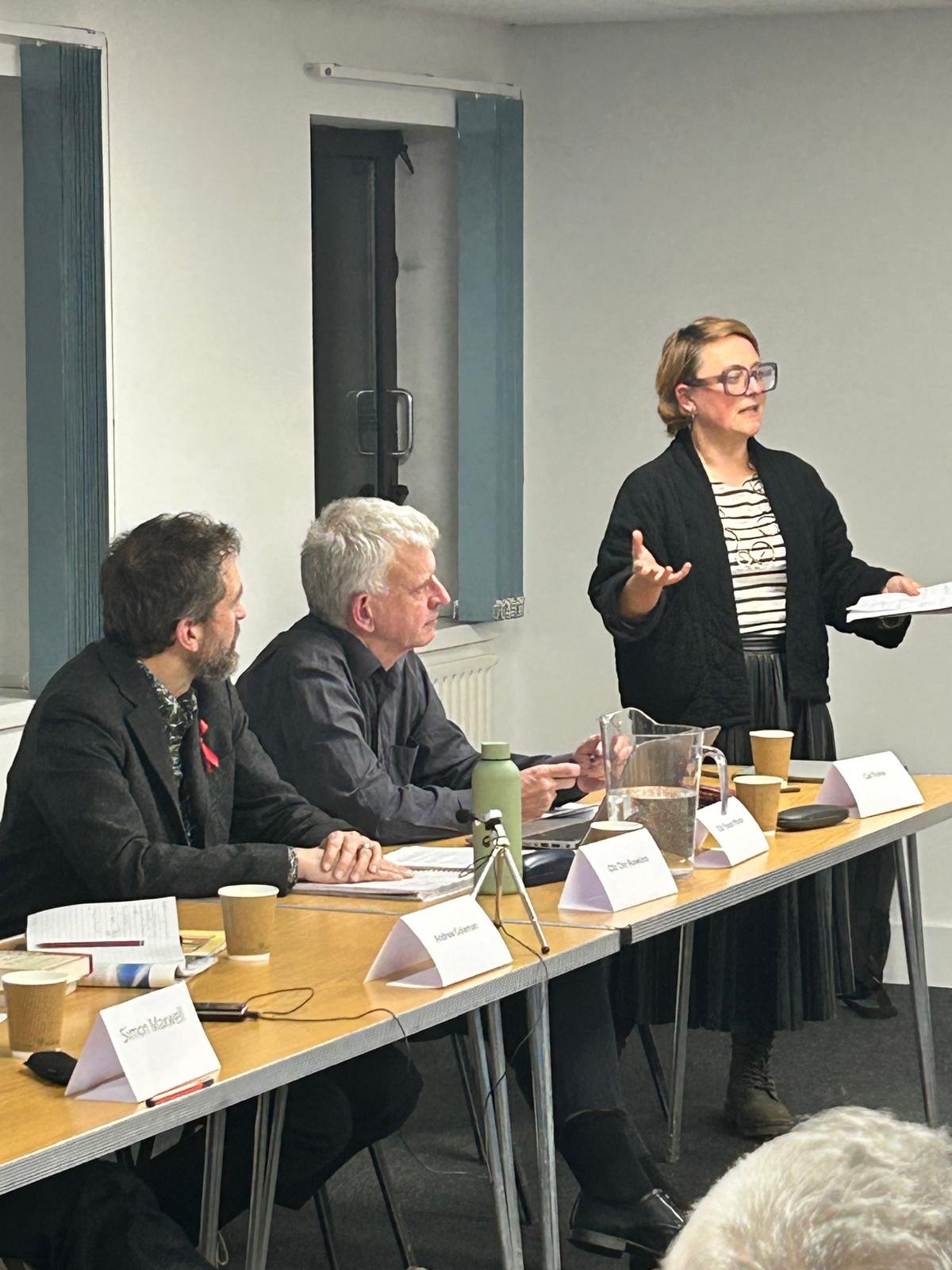
Cat Fisher spoke from her experience of convening discussions about adaption with those tackling it, internationally, nationally and here in Brighton and Hove. She argued that adaptation is an equity issue, as the risks of climate change are not evenly distributed. This is a particular challenge in our unequal City. Many of the factors that led disadvantaged and marginalised communities and individuals to be more impacted by COVID such as existing health conditions, poor quality housing, lack of green space and low social cohesion, also meant they were at greater risk from hazards such as excess heat. Communities were feeling these impacts and were responding, for example by providing cool spaces in hot weather. It was important to build on these bottom-up initiatives and improve participation and governance to make sure that people were fully involved in decisions – involving all different perspectives and skills. This means adaptation was also a governance issue. Forthcoming devolution provided an opportunity to put people at the heart of place-based decision-making that was needed for adapation. Adaptation was also a skills, mindset and co-ordination issue, one that required convening and mobilising across silos, involving different perspectives, skills, experiences, expertise and creativity to move toward being a more equal, adaptive City. An audio recording is here.
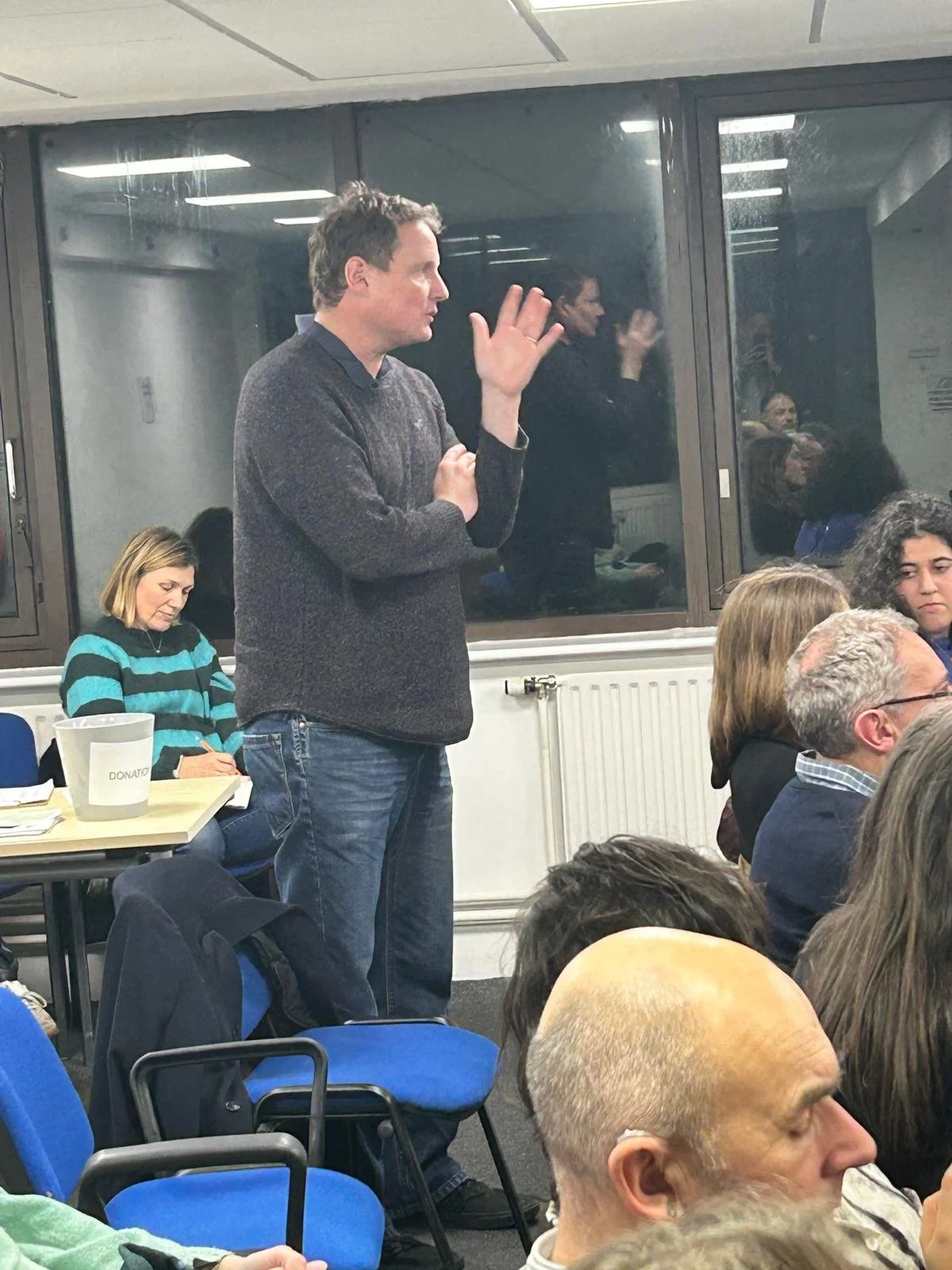
The discussion covered various topics:
The impact not just of average changes in e.g. temperature or sea level, but extremes in the tail of the distribution;
The importance of heat, as the biggest killer resulting from climate change, with air conditioning as a possible priority;
Issues about insurance, especially the non-insurability of some properties;
The essential need to connect different vulnerabilities, especially among disadvantaged communities, for example with respect to health, and also cascading shocks when one shock followed another;
Enthusiasm for the role of cultural actors in developing and sharing stories;
The vital importance of listening to and working with communities from their own perceptions of risk, and priorities;
The need to review regulations to make adaptation easier, for example for community energy projects; and
A generalised request for more and better consultation.
Closing the discussion, the panel welcomed the discussion and the big themes, including the need for a bottom-up approach, and the need to focus on the most vulnerable facing interlocking vulnerabilities. It was important in this process to think systemically, at landscape scale, and look at the respective roles of the Council, the private sector (including Southern Water and developers) and residents. There were good themes to develop, including bringing future generation voices into the conversation, nature restoration, and building on community commitment to bouncing forward. A final lesson was that the adaptation issues discussed provided a very good way to open up discussion of climate action, avoiding some of the political minefields surround e.g. the net zero debate.
Simon Maxwell thanked the audience for great contributions, and the speakers. Referring to Andrew’s discovery of climate heroes, he thought there were many in the room. Climate:Change was attempting to build knowledge communities on climate topics, and the meeting represented a very positive step in that direction.
___________
Simon Maxwell
December 2025
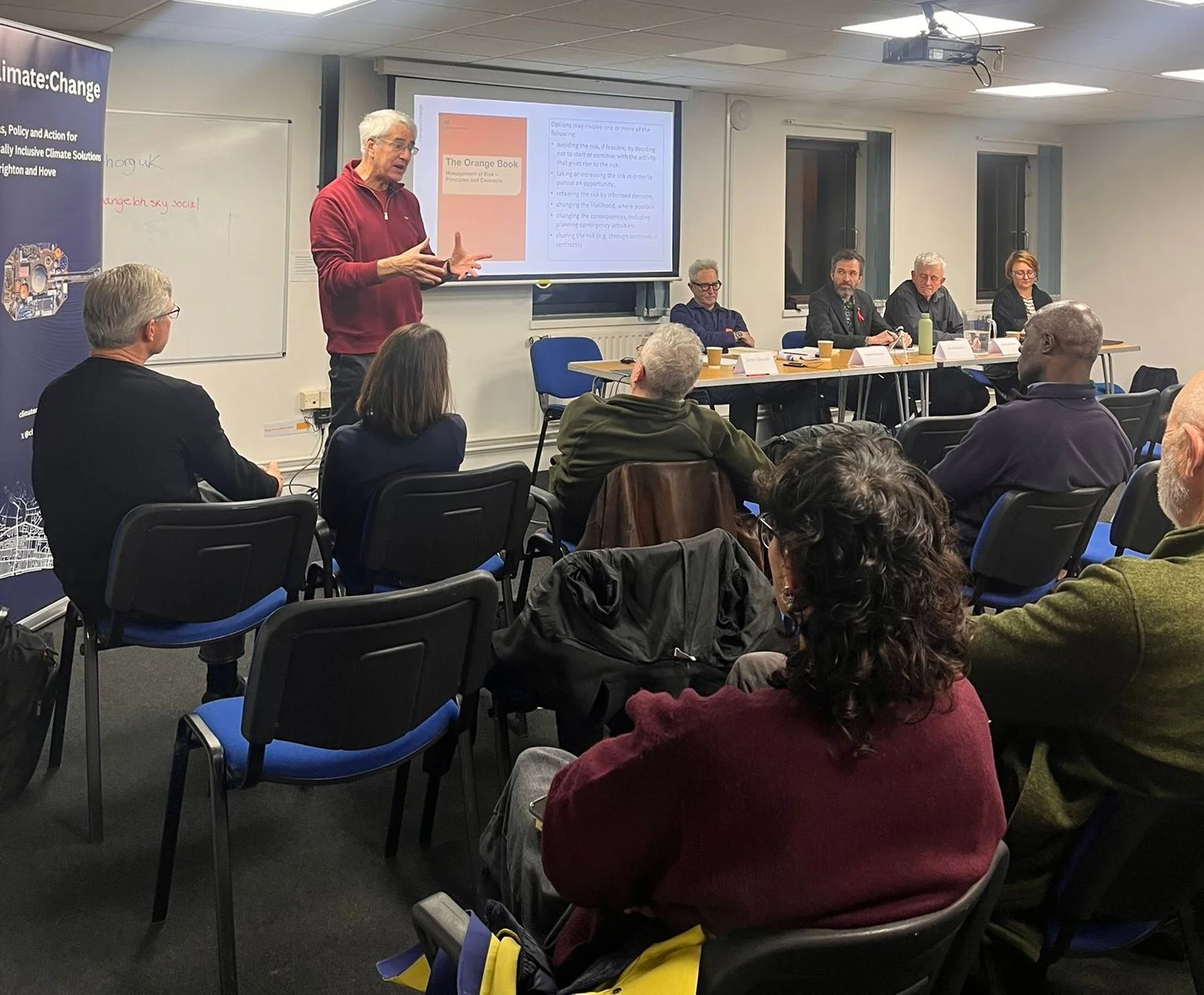
A contribution from the audience (Tom Mitchell)