
Book Review. The Growth Story of the 21st Century: The Economics and Opportunity of Climate Action
The Growth Story of the 21st Century: The Economics and Opportunity of Climate Action
Nicholas Stern
Sambit Bhattacharyya, Simon Maxwell and Max te Velde
Key Points:
Nick Stern is one of the good guys. In this book, he offers ‘an argument of opportunity’ - the investments and transformations necessary to tackle the climate and biodiversity crises can create new paths for development and growth that are sustainable, resilient, and inclusive.
The key messages are that:
action on climate change is urgent;
a just transition is needed;
the economics is favourable (because ‘clean is cheaper than dirty’);
and active states, collaborating globally, can tackle the problem.
Investment is key.
‘Degrowth’ is not the answer. Instead, Stern argues that the real challenge is to break the link between consumption and production on one hand, and emissions and environmental damage on the other.
There are six key drivers of new growth: innovation and technical change, driving down costs, also rising productivity at system level, better directed investment, and, reflecting the concern with just transition, the impact of investing in health on both well-being and productivity.
Stronger system productivity is key: the investment, innovation, and structural change necessary to strengthen the productivity of big systems – energy, transport, cities, land, and water – will increase productivity across the board.
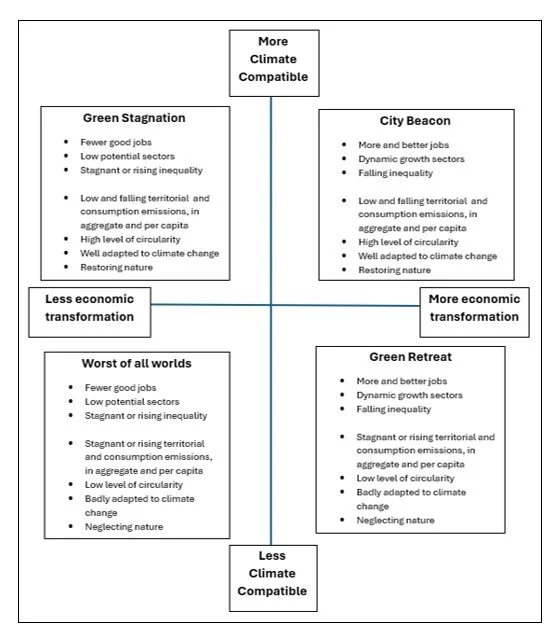
Is this analysis relevant to Sussex and Brighton and Hove? Of course – especially to an overall vision offering both economic transformation and climate compatibility. The principles are well-reflected in the Brighton and Hove Economic Plan, and in the new Strategic Framework of the Sussex and Brighton Combined Authority (SBSA).
Stern’s book validates the What and Why. It also helps with the How – especially via the specifics of the growth drivers.
Perhaps most challenging will be to keep environmental issues, including climate and nature, central as the SBSA develops its Prosperity Strategy, and being sure to include resilience and adaptation as planks of the strategy.
Nick Stern has written an important book on the implications of climate change for growth policy, ‘The Growth Story of the 21st Century: The Economics and Opportunity of Climate Action’. We review the main arguments and conclude with observations for Sussex and Brighton and Hove.
Stern is one of the good guys. As a Professor at the LSE and a Fellow of the Royal Society, he is a highly-respected academic, whose original field work in the Indian village of Palanpur goes back to the mid-1970s. As a former Chief Economist of the World Bank, Second Permanent Secretary of the UK Treasury, member of the House of Lords, and member of more high-level international commissions than most of us have had hot dinners, he is quintessentially an establishment figure. Also, as the author of the Stern Review on the Economics of Climate Change in 2006, and deeply engaged on the topic to this day, he is someone who has challenged conventional economic thinking and policy practice, drawing on his experience and on openness to other disciplines in order to chart a way out of the calamity that is climate change.
The new book is wide-ranging, academically rich, policy-relevant, and relentlessly optimistic about the options: it offers ‘an argument of opportunity’. That is a cause for celebration. The key messages matter: action on climate change is urgent; a just transition is needed; the economics is favourable (because ‘clean is cheaper than dirty’); and active states, collaborating globally, can tackle the problem. Investment is key. As Stern says:
‘The investments and transformations necessary to tackle the climate and biodiversity crises can create new paths for development and growth that are sustainable, resilient, and inclusive. This is the central argument of this book. These new pathways will be far more attractive than the destructive, high-carbon paths of the past. However, the scale, urgency, and complexity of realising the necessary investments, innovations, and systemic transformations present formidable challenges.’
The book consists of 11 chapters, divided into four parts:
First, ‘Foundations: a world re-drawn and an urgent agenda for action’, which contains quite a lot of climate science and a history of climate negotiations, but also a critique of economic growth theory, and a foray into politics and ethics.
Second, ‘The new growth story: investment, innovation and fundamental structural change’, which explores the drivers of growth, the need for investment and finance, and the new role of the state.
Third, ‘International action’, making the case for global inter-dependence, and reviewing the need for and sources of finance.
Fourth, ‘Galvanising action’, dismantling the arguments of those who call for delay, and concluding with a call to action.
The book is readable, and attractively presented, with summary tables throughout: Powerpoint ready, one might say.
A just transition
Justice, equity and social capital
Turning first to the question of the ‘just transition’, it is commendable that Nick Stern puts income and equity, participation and power, at the heart of his analysis. The argument is rooted in the theory of Amartya Sen on justice, and on the practical framework of the Sustainable Development Goals of 2015 – all 17 goals and 169 targets. Empirically, Stern ranges from the dislocations of past industrial revolutions through to deindustrialization in the UK under Margaret Thatcher, and the impact of shocks like the Global Financial Crisis or Covid. There are lessons to be learned from history, but the transition required to deal with climate change is distinctive: it brings together a ‘combination of all of scale and urgency, medium and long term processes, and economy-wide impacts’.
In Stern’s thinking, the key to unlocking a just transition is to focus on three concepts, justice, equity and social capital. These are ‘both ends and means in the policy-making process’: for example, social capital is an objective on its own account, but through participation and trust-building, also a means to better climate policy.
In terms of actions, Stern focuses on the following: local skills and investment; lifelong learning; relocation of public services; cost and availability of capital; tackling the effects of price changes; and social protection. He offers practical examples, for example Spain investing in programmes in former mining regions, or the UK moving the management and operation of social security programmes from richer to poorer regions. These initiatives are not cheap, however: Stern notes that ‘in poorer countries, external aid at low or zero cost may be necessary’.
Crunchy choices
If there is a criticism to be made, it is that the choices, trade-offs, sequences and potential conflicts are perhaps more difficult than Stern allows. Across the Western world, debates are active about the speed and cost of the transition, often polarizing, and rooted in the exact dislocations and distributional impacts that Stern identifies. Net zero, for example, divides parties in the UK.
It is all very well to argue, as Stern does, that if German farmers protest against the loss of subsidies on diesel, or the gilets jaunes in France take up arms against higher fuel taxes, then the answer is ‘to implement comprehensive packages of measures within which the negative impacts are mitigated’. Great: who pays, and how much?
Nick Stern will certainly have views about current issues like the timetable of the UK Government’s ambition for net zero in the power sector by 2030, or about the coverage and level of carbon border taxes in the EU and the UK, or about the timing of phasing out internal combustion engines: it would have been good to see them in the book.
It is also worth saying that the crunchy choices have long been prominent in the debate about just transition, and its various analogues: sustainable development generally, the green and global green new deal, doughnut economics, and climate compatible development. The trajectory of these in many cases pre-dates the appearance of ‘just transition’ in the climate literature. Doughnut economics gets one brief reference in the book; neither the green new deal nor climate compatible development merit a mention. To take just one example, the concept of climate compatible development, dating from 2010, has generated a literature on the potential or otherwise of ‘triple-wins’, incorporating mitigation, adaptation and long-term transformation.
Delving into these other literatures might have widened the policy set that Stern examines. Without endorsing particular options, it is notable that there is no mention in the book of explicit redistributive policies like wealth taxes or universal basic income, or of transactions taxes, with only one mention, in a footnote, of airline taxes.
The new growth story
Why degrowth is the wrong answer
Some will question why growth is even on the agenda. Surely achieving sustainability requires less consumption not more?
Stern disagrees. ‘At a basic level’, he says
‘the argument that degrowth is essential for achieving net zero is flawed, particularly if it claims that emissions cannot be reduced unless consumption is also reduced. Such an argument would imply that net zero emissions can only be achieved if consumption is reduced to zero, unless a massive CO2 removal programme is implemented.’
That is probably a stricter version of the case than even hardened advocates of degrowth would offer. A ‘softer’ version suggests that ‘reducing consumption could or should help reduce emissions as part of a broader strategy’. Stern does not like this either:
‘The real challenge is to break the link between consumption and production on one hand, and emissions and environmental damage on the other. That is where the major changes must occur. . . . Even if pursued, a modest reduction in consumption would be, at best, a small part of the solution. Worse, insisting on it could generate hostility to the entire climate action agenda; it could be powerfully counterproductive.’
Our own work on degrowth rather confirms that view.
The drivers of growth
Stern identifies six key drivers of ‘the new growth story’ (Box1). These include innovation and technical change, driving down costs, also rising productivity at system level, better directed investment, and, reflecting the concern with just transition, the impact of investing in health on both well-being and productivity.
Box 1
The six key drivers of the new growth story
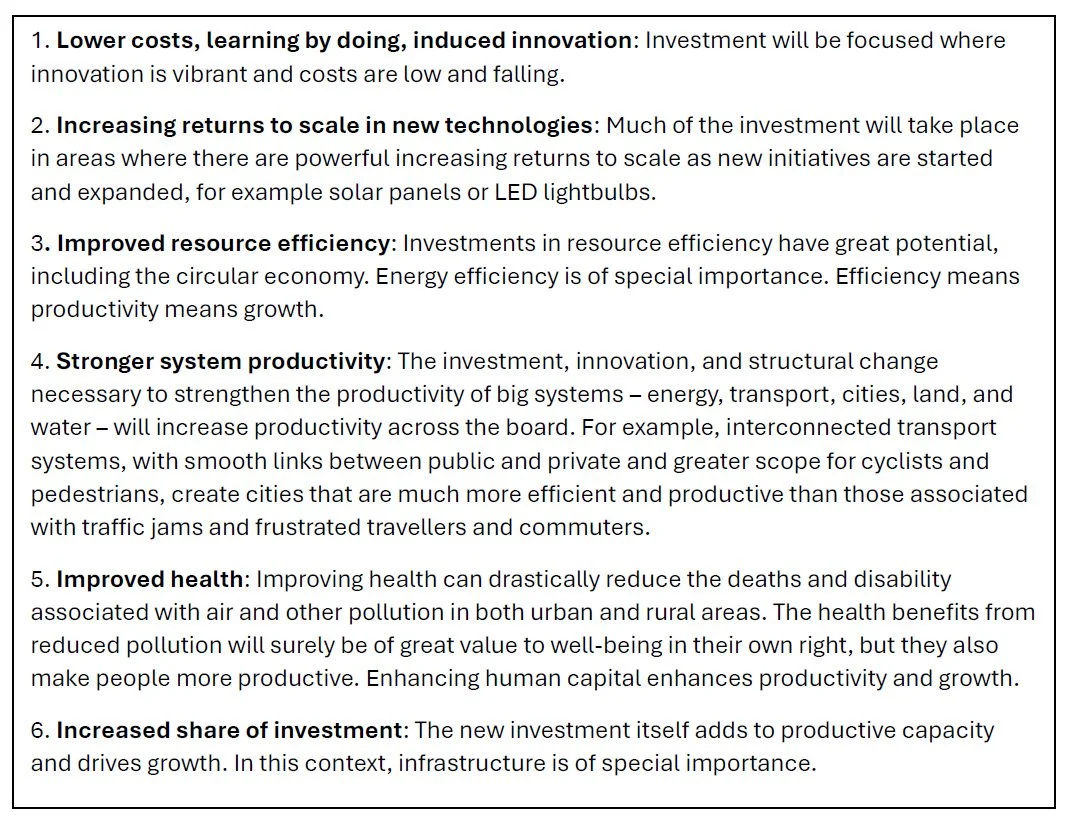
The drivers are undoubtedly important in improving our understanding of the type of growth that is needed. Their application in the context of understanding green transition is a valuable contribution.
There is some exaggeration. Stern claims that ‘most macro modelling and analyses of output growth largely ignore the six crucial drivers, with the exception of the last’. Not so. A whole class of endogenous growth models deal with increasing returns to scale, market structure, innovation, learning by doing, system productivity, efficiency and structural change. Similarly, overlapping generations models and heterogeneous agent models also deal with the growth effects of improved health, longevity, and ageing.
Never mind. We can agree that Investment is key. Much of it will support or create public goods, like infrastructure, skills or health, and the track record of private investment in delivering high social returns in these is not very impressive. Public investment is then a preferred option. In particular, public investments in system productivity, health, and skills are likely to offer the highest social return in terms of inclusive growth and jobs. Energy, transport, cities, land and water system transformation led by public investment will be able to deliver the sustainably sourced resources in abundance that the private sector and consumers of a future economy will need for a successful transition.
For private sector investment, continually updating the regulatory and institutional framework will be beneficial in consumer-focused markets that can accommodate competition.
Failure in any of the above will trigger a backlash that will inevitably derail transition. However, as Stern aptly puts it, ‘tackling the climate crisis embodie[s] a tremendous investment and growth opportunity’.
The global geography of growth
The question of where growth is needed or might happen is also important. Stern is right to say that, ‘the developing world is at centre stage in the new growth story’ as the economic centre of gravity decisively starts shifting East. The assessment that ‘the new growth story unlocks new employment opportunities for employees, the self-employed, and entrepreneurs’ is also correct, as the scale advantages of a spatially concentrated workforce dissipate with the advent of digital technologies supporting remote work and micro innovation: this might be thought to favour the developing world.
We can agree that the developing world is likely to grow faster than the advanced economies over the next few decades. However, growth and industrialisation for an inclusive green transition is equally important for the advanced economies: Stern would surely agree.
Stern correctly points out that outcomes are dependent on policy choices and these choices create winners, losers, and externalities.
A case in point is the distributional politics of international trade. Growing evidence from the labour market of advanced economies indicates that the WTO-led wave of globalisation over the last three decades has not had unambiguously positive outcomes on well-remunerated jobs, even though consumers may have benefitted. This undoubtedly strengthened negative political discourse around international commerce that we now see manifested in the protectionist trade policies of many developed nations.
So, does Stern offer ideas for growth in his book? The answer is plenty. However, they are overly focused on developing countries. As a result, Stern ignores consequences for developed nations inadvertently or otherwise. If a global transition is to succeed, then it must also succeed in developed nations. The idea can no longer be sold in developed nations as distributive justice solely between rich and poor countries.
Finance, governance and institutions
Many policy dilemmas can be resolved at national level. That is why national plans submitted to the UNFCCC as Nationally Determined Contributions, should not just deal with narrow GHG issues, but should embrace transition more generally. It is also why conditional NDCs are especially valuable in requiring countries to estimate more accurately what the costs of just transition might be. Just Energy Transition Partnerships (JETPs) offer some potential to operationalise the outcomes.
However, national policy also rebounds internationally. Stern rightly has a section on climate action as a means to deliver a stable climate as a global public good, and makes reference to technology sharing initiatives like the International Solar Alliance. It would be interesting to investigate how far cooperation of this kind undermines the race for national competitive advantage. But even in benign circumstances, there are challenges. For example, many developing countries have newly-discovered oil and gas resources, the exploitation of which, absent countervailing measures elsewhere, would dramatically breach the carbon budget. Either existing fields must be mothballed, or compensation paid to prevent development of new fields. How an issue like that is resolved between countries is at the core of a just transition.
The importance of global cooperation
Indeed, global cooperation is critical. Trust is at the heart of this – and in short supply. Stern discusses recent disastrous withdrawals from multilateral climate commitments, and attacks on environmental science: these only act to decrease trust and cooperation.
Some argue that global cooperation is increasingly threatened by China’s persistent dominance in clean technology. With 58% of lithium processing and 65% of cobalt processing, they possess an overwhelming advantage in the manufacturing of solar, batteries, and EVs (Table 8.1). This means that the clean energy transition will proceed on Chinese terms unless other global superpowers increase their own capabilities. Fortunately, Stern is confident that the shared logic of clean energy economics will override future geopolitical issues.
In order to facilitate transition at a global scale, there must be cooperation and collaboration between governments and institutions. Stern has attended every UN climate COP since 2006 (p.xx) and has co-chaired major commissions on climate finance, so he understands the importance of how different bodies must interact to effect change. There is a fundamental issue that the UNFCCC (United Nations Framework Convention on Climate Change) provides the framework (and political legitimacy) for emissions commitments, but ‘lacks financial resources and acts more as a political vehicle for the creation of agreements than as a direct investor in climate action’ (p. 327). Despite consecutive COPs, institutions with genuine financial leverage are governed by their shareholders, whose priorities do not always align with the urgency of the climate problem.
The COP process itself is unsatisfactory. COP29 in Baku (November 2024), designated as the ‘finance COP’, agreed on a New Collective Quantified Goal (NCQG) framework whereby the goals of COP 15 (Copenhagen, 2009) and COP 16 (Cancun, 2010) of US$100 billion per annum of flows by 2020 were replaced with a US$300 billion per annum by 2035 commitment. Stern has a harsh assessment of this, noting that the focus on 2035 was too late and that the financial goal itself falls short of the necessary finance requirements.
There is thus a risk that developing countries conclude there is an unwillingness to meet climate obligations, creating knock-on effects which further decrease trust.
The need for more international climate finance
Stern identifies five finance/investment categories: the clean energy transition; adaptation and resilience; loss and damage; natural capital; and just transition. He claims these categories must globally reach US$6.5 trillion per year by 2030 (Table 9.1). This is in contrast with current total global climate finance, which is a record 1% of global GDP; US$1.9 trillion in 2023 and US$2 trillion in 2024 (IEA, 2025) (CPI, 2025).
This means there is a large structural financing gap for total climate investment. Further to exacerbate this problem, the current financing is unequally distributed, with developing economies only receiving 15% of global clean energy investment, despite high population and renewable energy potential.
Stern guides readers through this paradox, where the African continent has a high capacity for quality solar resources, but only attracts around 2% of global solar investment. This, he asserts, is a market failure driven by risk aversion and high costs of capital.
In section 6.4, he studies the financing gap, arguing largely in favour of multilateral development banks (MDB) as the bridge to deliver the finance capability to the developing world; to lend, manage risk and attract capital, especially for underfinanced regions which need climate compatible development the most.
Stern suggests multiple reforms for making MDBs ‘Better, Bolder, and Bigger’ (p. 329); more willing to take risk, more engaged with the private sector, and with increased scale of lending. He also suggests that developing countries must make fundamental macroeconomic changes, for example shifting focus to debt restructuring instead of raising capital.
International taxation is not much discussed in the book. However, there is a strong case for raising taxes on high net worth individuals to fund public investment. Admittedly there would be risks of capital flight if countries were to go alone on taxing wealth and high income. Therefore, a global accord on taxation would be right way forward and that would require careful work on building trust among nations
Qualifications aside, the main ideas throughout the book persist; 1. these flows are necessary, 2. developing countries cannot afford not to transition and 3. international flows are an investment which the whole world will benefit from. Stern concludes, that the fundamental issue still remains, whether or not global institutions can actually translate policy to action.
Sussex and Brighton and Hove
Nick Stern’s book is global in scope. Does it have any relevance to Sussex and Brighton and Hove? Of course.
The City Beacon model
Brighton and Hove has an Economic Plan, reviewed by a group of us for Climate:Change and discussed at a public meeting. The Climate:Change website has many entries on growth and economic development. The overall vision is described as the City Beacon, offering both economic transformation and climate compatibility (Figure 1).
Figure 1
City Beacon
Source: Economic Development in Brighton and Hove and in Sussex
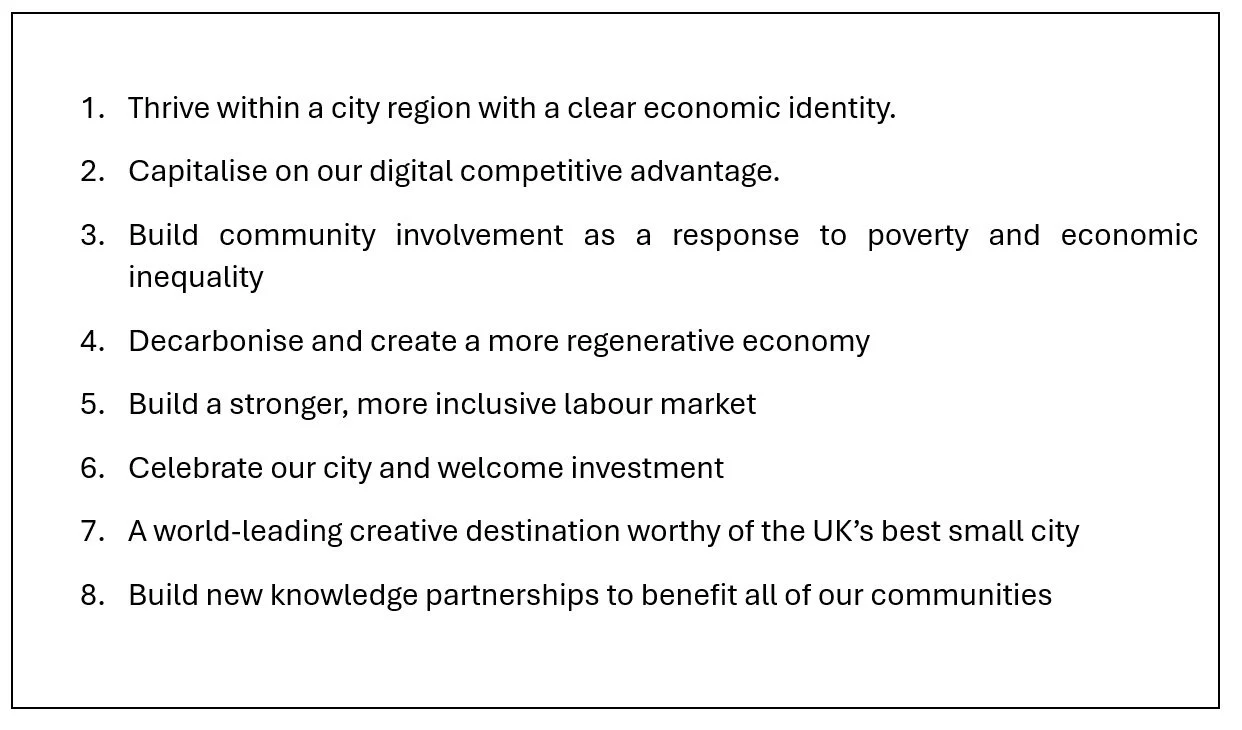
There are 8 strategic priorities in the Brighton and Hove Plan (Box 2).
Box 2
Strategic Priorities of the Brighton and Hove Economic Plan
Meanwhile, the new Sussex and Brighton Strategic Authority is developing its own Strategic Framework, intended to ‘define the long-term vision for prosperity, inclusive growth, sustainability, and improved quality of life’. Figure 2 illustrates the vision, with investment plans proposed for a range of sectors, including economic development, transport, skills and health.
Figure 2
The SBSA Strategic Framework
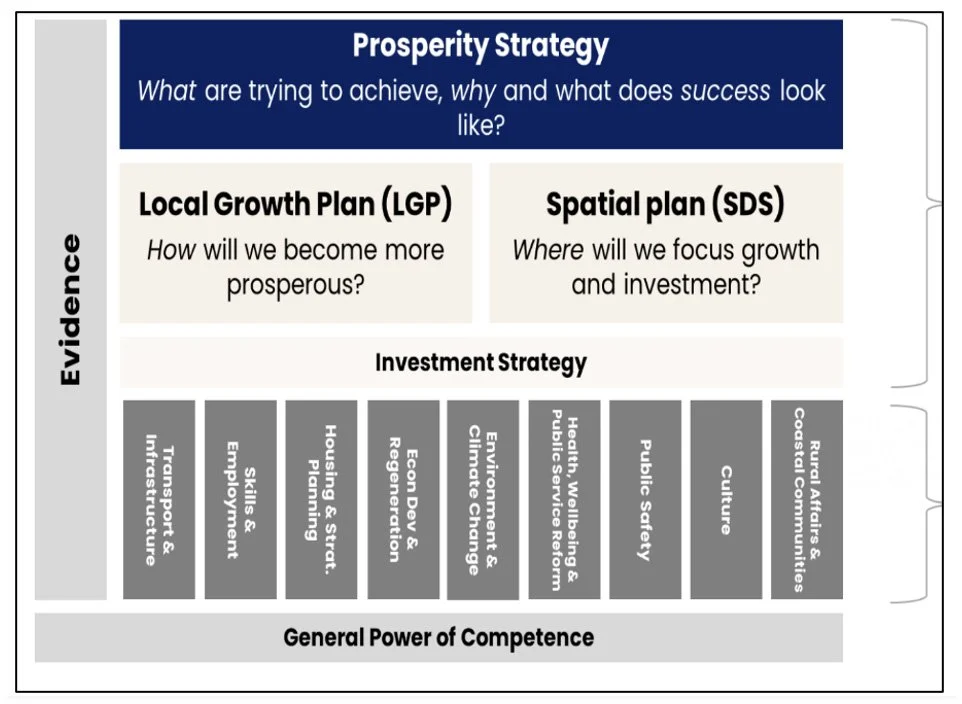
Much of this resonates with Nick Stern’s perspective. The importance of investment, not just in economic enterprise, but also in skills and health, always with an environmental focus. The focus in the Brighton and Hove Plan on inclusion and community involvement is also ‘Stern-compatible’.
As Brighton and Hove, and Sussex, move from the ‘Why’ and ‘What’ of high-level strategies, to the ‘How’ of actual policy, Stern’s drivers of growth will be relevant (see Box 1 above). For example, his emphasis on economies of scale in new technology has implications for the planning system; also the focus on building integrated city systems.
Perhaps most challenging will be to keep environmental issues, including climate and nature, central as the SBSA develops its Prosperity Strategy, and being sure to include resilience and adaptation as planks of the strategy. The commitment to expand capacity at Gatwick, with an extra 100,000 flights a year, presents an emissions challenge, alongside the opportunity for job creation. And house-building targets present a potential threat to nature and green spaces in the region. Analysis by Climate:Change has consistently focused on these issues.
_________________
Sambit Battacharyya is Professor of Economics at the University of Sussex. Simon Maxwell is Co-Chair of Climate:Change. Max te Velde Max te Velde holds an MSc in International Finance and Economics from the University of Sussex.
Perspective pieces are the responsibility of the authors, and do not commit Climate:Change in any way. Comments are welcome.