
Research Report: The Saltdean Decarbonisation Plan - a model for local planning
The Saltdean Decarbonisation Plan - a model for local planning
Key points:
Saltdean is mostly residential, with a population of about 9,000 people and total territorial (not consumption) emissions of about 19,000 t CO2e - about 2t/cap.
Domestic heating accounts for 53% of Saltdean’s territorial emissions and transport for a further 29%: these are the major sectors.
In the leading scenario, nearly all vehicles are electric by 2050, and 95% of homes have heat pumps. 80% of homes have solar panels. There is large-scale retrofitting to improve thermal efficiency.
There is a small residual need for off-setting, some of which could be manged by planting trees, resulting in the co-benefit of cooling streets to combat rising temperatures.
There is some scope for community energy, mainly in the form of rooftop solar on community buildings, with the possibility of a wind turbine.
Cumulative investment by 2050 is £20m, more than offset by savings on electricity use and by exports to the grid.
Climate:Change is grateful to be allowed to publish the Summary Briefing of a new report, prepared by Brighton & Hove Energy Services Co-operative (BHESCo), in partnership with the Saltdean Climate Action Network (SCAN). The report provides a costed roadmap of how Saltdean might reach net zero territorial emissions by 2050. This is mainly by installing heat pumps in most houses, and transitioning completely to electric vehicles. Is this practical approach a model of how to approach decarbonisation in other parts of the City?
We would like to hear what people think about the report and the approach. Please use the comments box at the end of the post. We may even have some contributions of our own!
The full report can be read here.
Simon Maxwell
_____
Saltdean Decarbonisation Plan
Summary Briefing
What this plan is
The Saltdean Decarbonisation Plan is a masterplan, prepared by Brighton & Hove Energy Services Co-operative (BHESCo) in partnership with the Saltdean Climate Action Network (SCAN), setting out how the Saltdean area of the East Sussex coast can reach net zero by 2050. It was funded by a grant from the Great British Energy Community Energy Fund (GBE-CEF) and follows national Local Area Energy Plan (LAEP) guidance, adapted to fit a community of this size.
Saltdean sits between the sea and the South Downs National Park, and is split between two local authorities - Rottingdean & West Saltdean (Brighton & Hove City Council) and East Saltdean & Telscombe Cliffs (Lewes District Council), which adds complexity to data-gathering and delivery. The area has around 4,525 mostly low- density homes (over 75% houses or bungalows) and a population of roughly 9,300.
The plan starts from a detailed picture of current energy use and emissions, then models three future pathways to 2050, before setting out practical, near-term interventions for homes, transport, communal heating, energy generation, storage and the small non-domestic sector.

Saltdean's energy system currentlyproduces 19,222 tCO₂e per year. Heating is the largest source (10,229 ktCO₂e), followed by transport (5,596 ktCO₂e), domestic electricity (2,039 ktCO₂e) and non-domestic energy (1,358 ktCO₂e).
Three scenarios to 2050
The study models three future energy pathways in five-year steps from 2025 to 2050. Nondomestic energy is held constant across all three, since it is a comparatively small part of the picture.
Baseline — a continuation of current trends: slow heat pump adoption, gas boilers predominate, limited (10%) thermal efficiency gains, EV uptake lags national targets, and only around 15% rooftop solar deployment. Used as a counterfactual comparator.
Moderate — a managed transition: heat pumps in ~70% of homes, 30% thermal efficiency improvement, EV adoption reaching ~80%, solar on ~40% of homes, and a growing role for small-scale community energy schemes.
Leading — the community's preferred, high-ambition pathway: heat pumps in ~95% of homes, large-scale retrofit delivering a 50% reduction in average heat load, near-total (~95%) EV adoption, solar on ~80% of homes, and a large community-owned renewable generation asset.
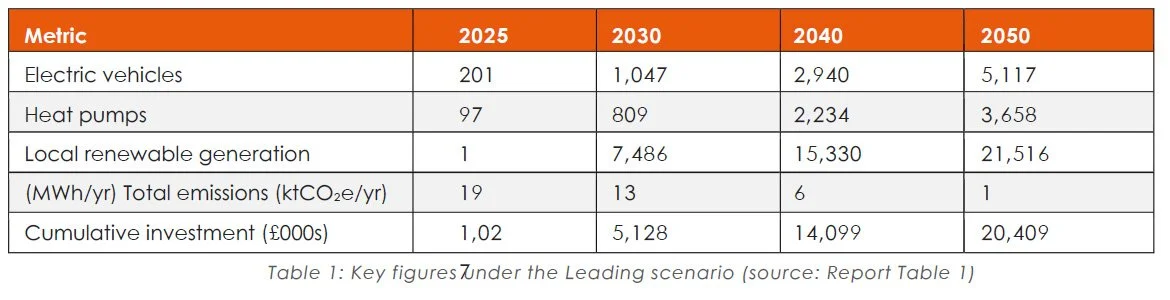
Under the Leading scenario, total emissions fall from 19 ktCO₂e/year in 2025 to around 1 ktCO₂e/year by 2050 — compared with 10 ktCO₂e/year that would remain under Baseline. Even in the Leading scenario, some residual emissions remain and will need offsetting to reach true net zero.
Table 1: Key figures under the Leading scenario (source: Report Table 1)
The single biggest driver of decarbonisation in every scenario is the electrification of heat — replacing gas boilers with heat pumps, closely followed by grid-level electricity decarbonisation, which is largely outside local control but is the biggest overall enabler. Electrifying transport and improving thermal efficiency both help, but the modelling shows thermal efficiency gains are consistently dwarfed by the impact of switching to heat pumps.
Decarbonising homes: heating comes first
85% of Saltdean's homes currently heat with mains gas. The EPC data (extrapolated to cover roughly a third of properties that lack a certificate) shows over 70% of homes rated D or below, with a mean gas use of 12,649 kWh/year — about 10% above the Ofgem medium-use benchmark.
Heat pumps: the priority action
Replacing gas boilers with air-to-water heat pumps is identified as the single most effective decarbonisation measure available to Saltdean residents. The plan assumes a realistic Seasonal Performance Factor (SPF) of at least 3.5, achieved through careful system design — in particular, sizing radiators for lower flow temperatures rather than relying purely on ('fabricfirst') insulation upgrades. 607 'priority' properties have been identified — those with low heat demand or already at EPC A/B — that could deliver most of the 809 heat pumps needed by 2030 under the Leading scenario. Average net cost per installation (after the Boiler Upgrade Scheme grant of £7,500) is around £5,140 today, expected to rise as system sizes and complexity increase for harder-to-treat homes.
Thermal efficiency: a pragmatic, not 'fabric-first', approach
Given the cost and disruption of deep retrofit, the plan recommends a pragmatic, case-bycase approach: roof insulation first (suitable in ~2,630 properties, typically £1,500–£3,000, 5–10% improvement), followed by wall insulation (£10,000–£50,000 depending on archetype, given Saltdean's high exposure to wind-driven rain) and floor insulation. Draught-proofing and ventilation improvements (avoiding damp while improving airtightness) are highlighted as highvalue, lower-cost measures.
Communal heating and heat networks
Saltdean's low housing density makes large-scale district heating uneconomic overall, but two potential small heat network areas have been identified: Lustrells Vale (132 flats) and around the Grand Ocean Estate (356 flats, in blocks up to five storeys). Feasibility depends heavily on the cost of new internal pipework, and funding routes such as the Green Heat Network Fund require a combined annual heat load above 2,000 MWh. Chichester Close already runs a successful communal biomass system for 15 homes; Martlet House (41 retirement flats) is recommended for a future centralised heat pump.
Transport
Road transport is currently responsible for 5,596 tCO₂e/year. Saltdean is well placed for EV adoption; most homes have private driveways, and grid capacity analysis shows no constraint to charging infrastructure in the short to medium term. Only 180 of the area's ~4,729 vehicles are currently plug-in.
However, because the total number of vehicles is projected to keep growing, transport's share of Saltdean's total emissions actually increases over time even as EVs replace petrol and diesel cars, rising from under a third to nearly half of remaining emissions by 2050 in the Leading scenario. The plan therefore recommends complementary measures to reduce car dependency, such as e-bike uptake and improved local bus provision, alongside the EV transition.
Local energy generation and storage
Solar
Rooftop solar is Saltdean's biggest local generation opportunity: an estimated 3,738 households could host panels by 2050 under the Leading scenario, generating around 18.5 GWh/year. Larger non-domestic sites have also been assessed, including solar carports at Saltdean Lido's car parks (potentially 306–461 kW), a 45 kW system at Saltdean United FC's new clubhouse, and smaller systems at the two local churches.
Wind
A single 1 MW community-owned wind turbine is modelled as part of the Leading scenario, generating around 3 GWh/year. Suitable sites within Saltdean itself are very limited under current planning rules (50 kW / 15m height under Permitted Development), so a larger turbine would likely need South Downs National Park Authority consent — the SDNPA has indicated it may support up to 1MW capacity in an updated local plan, especially for community- led projects that address fuel poverty.
Storage and flexibility
Modelling suggests that, if EV batteries and home batteries develop as expected, no additional battery storage should be required to meet evening peak heat pump demand up to 2050 under either the Moderate or Leading scenario. Battery storage does, however, meaningfully reduce how much local solar generation is exported (rather than self- used) — home batteries could cut the local grid's midday summer export peak from around 3,200 kWh per half-hour to as little as 1,300 kWh with 10kWh of storage per solar system. There is currently sufficient capacity at the Rottingdean primary substation under all future energy scenarios through to 2050.
The future of main gas
Gas is not considered part of the long-term decarbonised energy system, but it remains present at declining levels through to 2050 in every scenario (reaching 19% biomethane injection by 2050 under Moderate/Leading). As demand falls, remaining gas customers could face rising unit costs and standing charges, increasing fuel poverty risk — a local community energy fund is suggested as one way to help mitigate this.
A local biomethane opportunity exists at Southern Water's Peacehaven treatment works, but a 2018 feasibility study found the ~14-year payback unattractive to investors, and regulatory restrictions currently prevent combining sewage sludge with food or agricultural waste in a single digester. This remains a longer-term, strategic option rather than a near-term deliverable.
Carbon offsetting and biodiversity
Even under the Leading scenario, some offsetting is needed to reach net zero - roughly 10,000 tCO₂e/year would still need offsetting by 2050 on current projections. Two local approaches are recommended:
Planting around 2,000 trees, targeting areas such as around Longridge Avenue, Coombe Farm and Saltdean Football Club, using the government-backed Woodland Carbon Code (payments of £10–£20 per tonne of verified offset, paid every 5–10 years).
Improving management of existing green spaces — grasslands and wildflower meadows act as faster (though smaller) carbon sinks than trees, and Saltdean already has 10 recognised Amenity Green Spaces, including the Mount Estate 'Three Greens', that could be enhanced through a community benefit fund.
These measures also support Saltdean's valuable chalk grassland and coastal habitats, part of the Brighton and Lewes Downs Biosphere Reserve, home to rare species such as the Adonis Blue Butterfly.
Non-domestic sector
Non-domestic energy use is a relatively small share of Saltdean's total emissions (1,358 tCO₂e/year) and data availability is poorer than for homes. Two priority sites have been identified for further feasibility work: Saltdean Lido, which remains a high gas user for pool heating despite an otherwise all-electric refurbishment, and The Spanish Lady pub. Saltdean Primary School (already hosting a 50kWp BHESCo-owned solar system) is a good candidate for switching its remaining gas heating to electric.
Investment, savings and community benefit
Under the Leading scenario, cumulative investment required rises to around £20.4 million by 2050, funding heat pump installation, solar PV and battery storage. In return, modelled savings on energy use and export income reach an estimated £39.1 million by 2050 — considerably higher than under Baseline (£14.5 million) or Moderate (£20.0 million).
The plan also highlights wider community benefits beyond bill savings: local jobs (peaking at an estimated 18 solar- installer roles in the mid-2030s under Leading), and revenue from community-owned generation assets that could be channelled into a local community benefit fund — supporting further offsetting projects, green space management and support for households in fuel poverty. A forthcoming regulatory change (expected via OFGEM in October 2026) would allow community energy organisations to sell power directly to local consumers without a full supply licence, which the plan flags as an important enabler for this local model.
Adapting to a changing climate
Alongside cutting emissions, the plan stresses the need to adapt to more frequent extreme weather — prompted by the record-breaking June 2026 heatwaves. Recommended measures include passive cooling (external shading, shutters, reflective roofing) ahead of active air conditioning, sustainable drainage (water butts, rain gardens, green roofs) to reduce flashflood risk, and expanding street trees and green infrastructure. Community-led microgrids and battery storage are also suggested as a way to improve resilience during periods of grid stress.
Conclusions and recommended next steps
BHESCo judges the ambitious Leading scenario to be plausible for Saltdean, provided momentum is sustained. Key recommendations include:
Prioritise heat pump rollout in the 607 identified priority properties, alongside pragmatic (not deep-retrofit) thermal efficiency improvements.
Commission individual feasibility studies for communal heating in blocks of flats, particularly around the Grand Ocean Estate.
Move quickly on local renewable generation in 2025–2030, since its decarbonisation value is highest before the national grid finishes decarbonising — medium-scale solar at sites like Saltdean Lido and Saltdean Football Club can help bridge the gap if the 1MW wind turbine target proves a stretch.
Define a community vision and governance structure for a Saltdean Community Energy Programme, so the community is ready to act as soon as OFGEM's local supply reforms take effect.
Support measures that reduce car dependency (e-bikes, bus provision), not just EV switching, given transport's rising share of residual emissions.
Progress the two priority non-domestic feasibility studies (Saltdean Lido, The Spanish Lady) and begin planning carbon offsetting/tree-planting projects, since woodland takes 10–15 years to reach peak carbon absorption.
Reassess the plan formally in 2030, once local government reorganisation (the Sussex and Brighton Combined Authority) is complete and progress against the modelled milestones can be reviewed — particularly as grid decarbonisation, the factor with the single largest impact, is largely outside the community's control.
____________
Simon Maxwell is Co-Chair of Climate:Change
Perspective pieces are the responsibility of the authors, and do not commit Climate:Change in any way.