
Four tests: Seeing the wood for the trees in our climate and nature conservation strategies
Julie Bygraves
Key points:
New Nature Recovery Strategies have been published for Sussex and Brighton and Hove.
They are badly needed. The UK is one of the most nature-depleted countries in the world.
Nature recovery can play a key part in tackling climate change: diverse ecosystems absorb carbon and therefore mitigate climate change, they reduce flood risk, and they nurture vegetation, both urban and rural, which tempers heat extremes.
The new strategies offer exciting opportunities. How will delivery be judged? There are four tests:
How will success be measured?
Do we have clear limits to urbanisation and land use intensity?
Will the rules on Biodiversity Net Gain be effective at the intersection of regional priorities with national policy?
Will ecological restoration be delivered beyond the confines of nature reserves, and deliver land management sympathetic to climate and carbon outcomes?
We need to see:
Measurement and surveys to demonstrate recovery of wildlife with biodiversity indicators.
A citizen-led debate to manage urban sprawl and land encroachment.
Tightening of the rules regarding Biodiversity Net Gain, eliminating loopholes which allow developers to damage nature.
Space for wildlife outside of the site-based nature reserves.
Nature conservation and democratising land-use decision making will create an enabling environment for climate action measures by local authorities. As the new strategies demonstrate, there are win-wins, if society places higher priority on wildlife, and asks how to conserve and restore nature, while also achieving climate and social objectives.
Why nature?
A healthy natural environment has many benefits – for health, well-being and food supply. Many argue that the natural world has intrinsic value, and a right to be protected from damage and degradation by humankind: Emma Montlake has made this case in a paper on environmental law for Climate:Change.
In addition, nature protection and recovery are at the heart of climate action.
Key to the climate agenda is that a diverse and healthy natural environment buffers human society against the excesses of anthropogenic and natural risk: diverse ecosystems absorb carbon and therefore mitigate climate change, they reduce flood risk, and they nurture vegetation, both urban and rural, which tempers heat extremes.
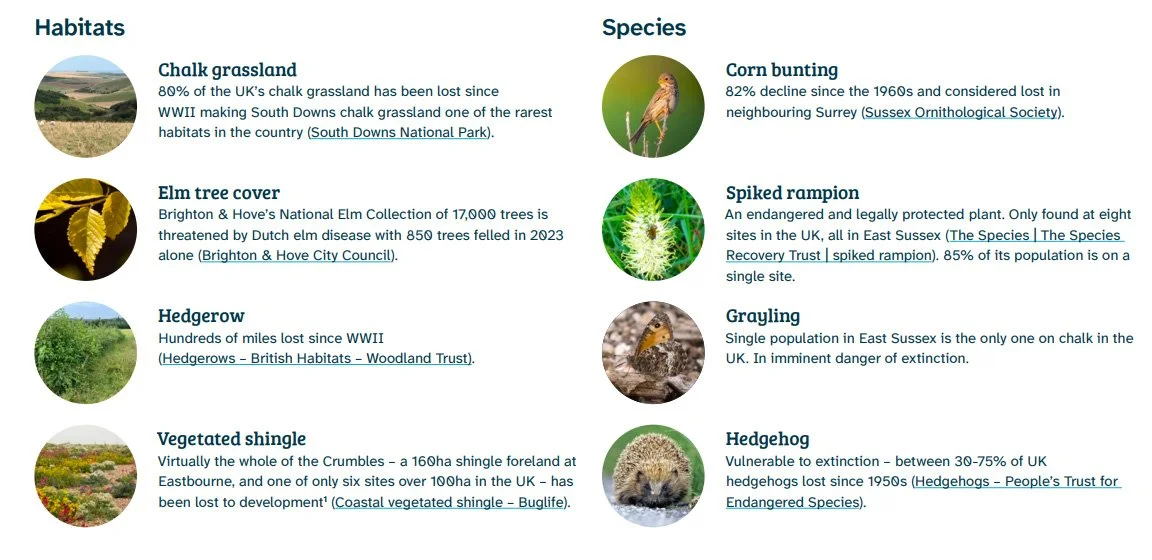
Nature-based solutions are necessary if we are to tackle climate change. Yet nature is in crisis, globally, in the UK, and locally in Sussex and in Brighton and Hove. According to the State of Nature Report in 2023, one in six of our UK species is at risk of extinction. Nearly half of our wildlife has been lost since the 1970s. The UK is one of the most nature-depleted countries in the world. See Figure 1 for the national picture, and Figure 2 for a local example from East Sussex and Brighton and Hove.
Figure 1
Nature depletion in the UK
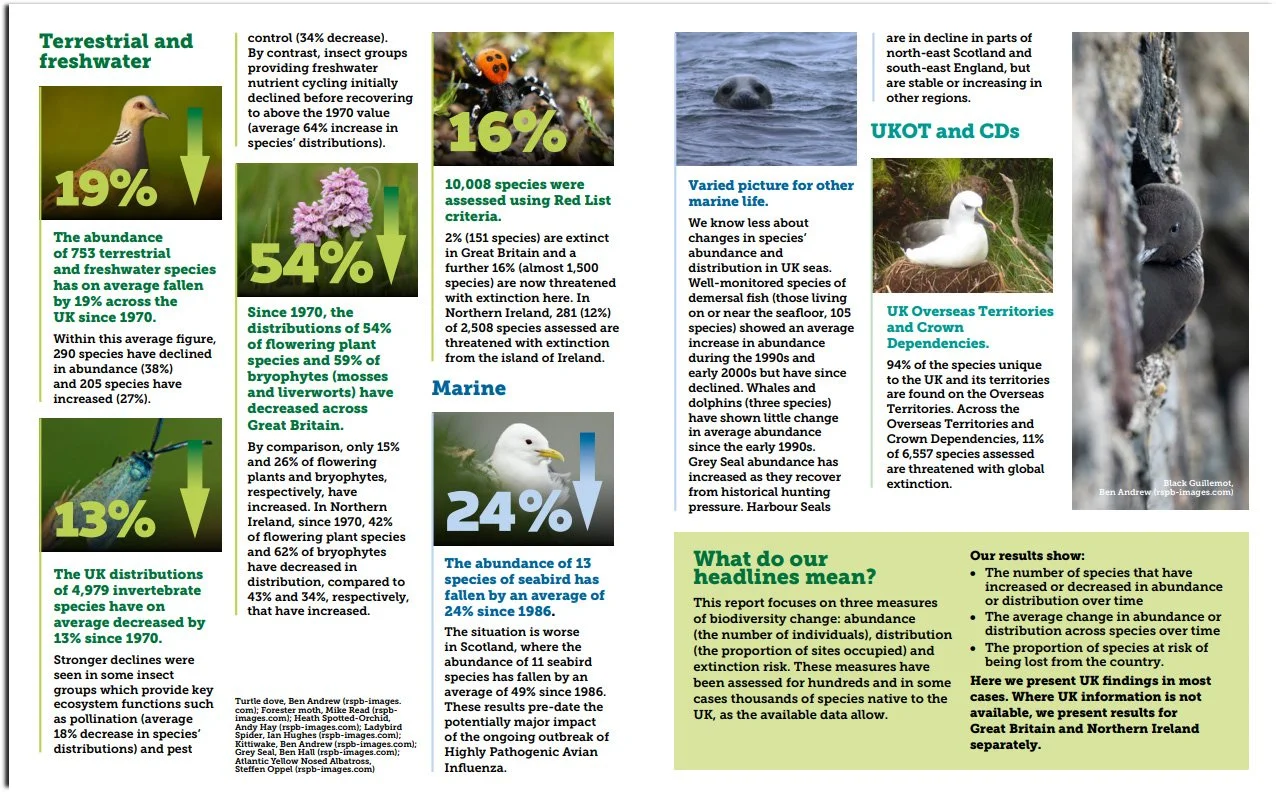
Figure 2
Habitats and Species in Decline in East Sussex and Brighton and Hove
Planning for nature recovery
Local Nature Recovery Strategies (LNRS) are intended to remedy this situation. They are a statutory requirement from the Environment Act 2021. Their aim is to protect the important places for nature that are left, and identify the opportunities to restore or create it, where it can have the most benefit for wildlife and people. 48 strategies are being prepared at the county level to cover the whole of England. There will be one LNRS for West Sussex and one for East Sussex, also covering Brighton & Hove. There has been extensive consultation.
In addition to all of this, Brighton and Hove has published its own nature plans, in the context of a new Climate and Nature Action Plan. There is a strong emphasis on nature-based solutions to what is described in the Foreword as an ‘existential climate and nature crisis’. The Report references the LRNS and says that
‘Nature in our city is under pressure—but it’s also full of potential. Brighton & Hove is home to an extraordinary range of natural habitats, from coastal waters to chalk downland and city parks to street trees. This action plan sets out how we will work to protect, restore and connect urban green spaces, support wildlife, and create a healthier biosphere. Together, we’re building a greener, more resilient city where nature is part of everyday life.’
So, what is on the agenda for nature in Sussex and in Brighton and Hove?
The LNRS for East Sussex and Brighton and Hove
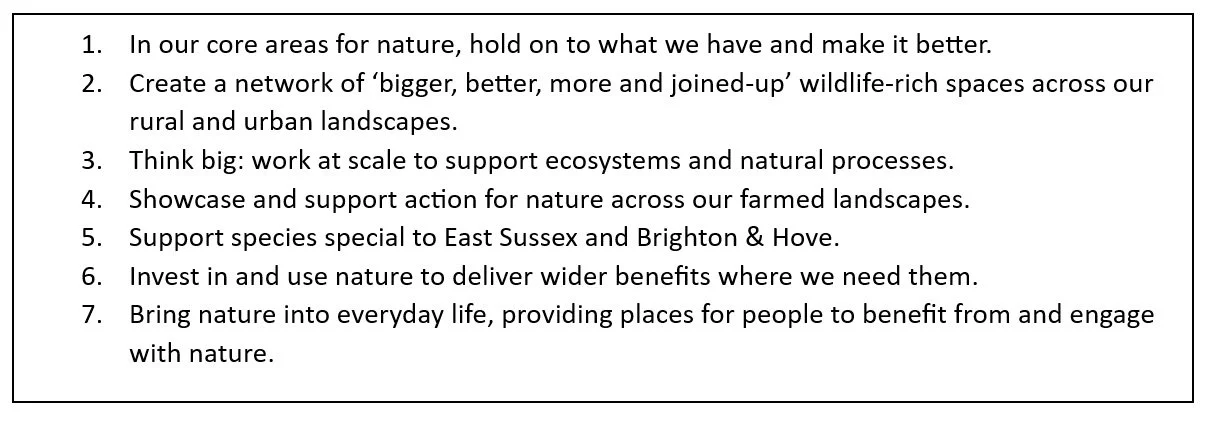
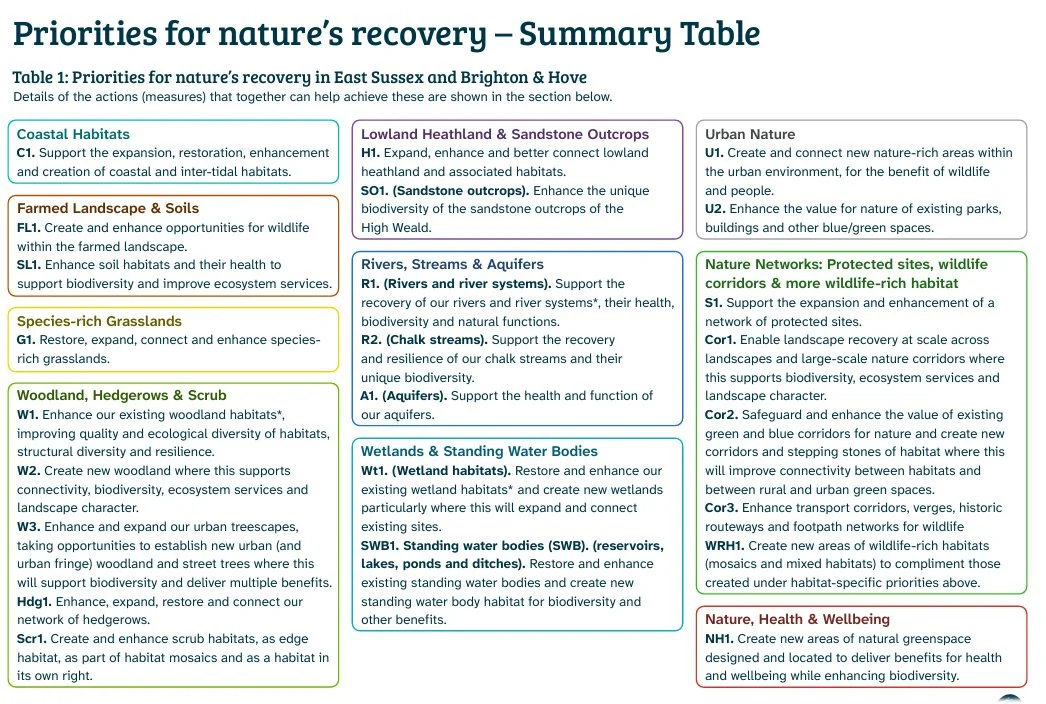
The strategy for East Sussex and Brighton and Hove has a focus on 10 different habitats (plus a catch-all on health and well-being), each with different needs and proposed programmes (Figure 3). It has seven policy priorities (Figure 4).
Figure 3
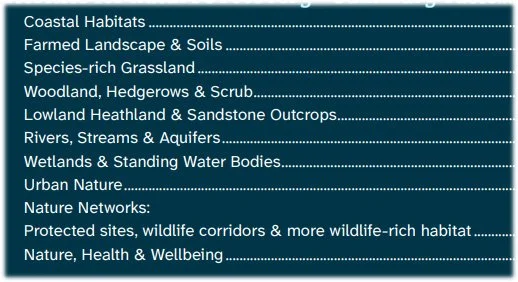
Source: https://ehq-production-europe.s3.eu-west-1.amazonaws.com/3dfdb30f52bd0a5ace49ff89ae0006aee11e3ed9/original/1760522263/9ea190d78a451225be10c0f56cf30a0e_Part%202%20LNRS%20East%20Sussex.pdf
Figure 4
Seven policy priorities for nature restoration in East Sussex and Brighton and Hove
In practical terms, there are actions for each element of the plan (Figure 5): for example, in urban areas ‘create and connect new nature-rich areas within the urban environment, for the benefit of wildlife and people, and enhance the value for nature of existing parks, buildings and other blue/green spaces.’ There are then more detailed recommendations, for example (Figure 6), new parks or green roofs on bus stops.
Figure 5
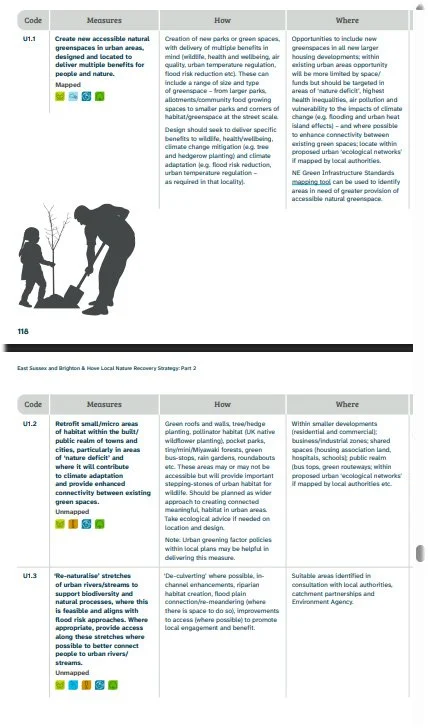
It is important to make the point that the LRNS is a strategy, not a costed work programme. The document is clear that
‘Delivering the priorities in this strategy will require funding. . . While we hope that the evidence presented in this strategy will support some funding bids and give confidence to investors regarding some nature recovery actions and locations, there is no guarantee that this is the case, and funding generally remains a key challenge.’
And
‘Local Nature Recovery Strategies are potentially powerful place-based tools designed to agree and identify the priorities and actions for nature in each LNRS area. . . . For the strategies to be effective, though, and not just aspirational, they must sit within a strong, supportive national and local policy framework. . . . Without this, there is a risk that despite the effort and consensus that these documents represent, they will ‘sit on the shelf’, failing to have the impact they are intended to have.’
The Brighton and Hove Climate and Nature Action Plan
The Brighton and Hove Climate and Nature Plan builds on the ideas contained in the LRNS and adds a practical action plan for the Short (2026 – 2028), Medium (2028 – 2030) and Long (2030 onward) terms. A multitude of actions is proposed, under three main headings:
Restoring Nature in the City
Restoring Nature in the City Downland Estate; and
Financing local nature recovery projects.
As an example, there are 11 actions recommended on the first topic, each assessed according to its contribution to the LRNS, and with a list of relevant actors and partners (Figure 7).
Figure 7
Restoring Nature in the City
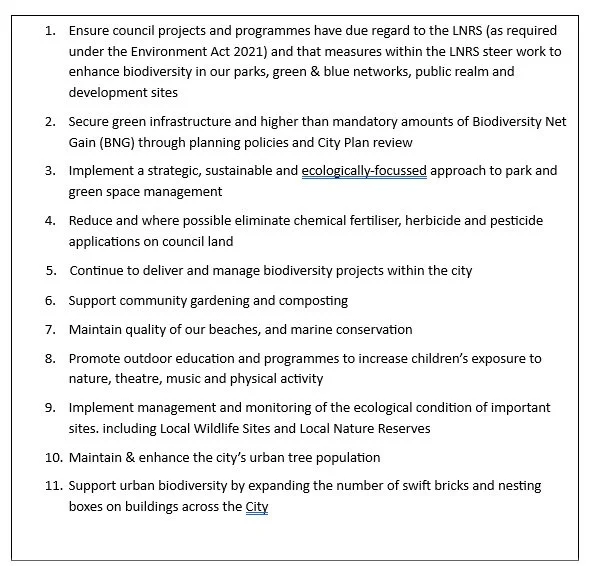
Source: https://www.brighton-hove.gov.uk/net-zero/brighton-hove-climate-and-nature-action-plan
Importantly, the Action Plan addresses the funding constraint noted in the LRNS. It proposes two initiatives, viz:
Develop Habitat Banks to attract investment in local nature recovery projects, enabled by Biodiversity Net Gain planning obligations introduced in 2024, and the sale of voluntary credits; and
Establish new vehicle to attract emerging green finance streams, and private donations to ensure long-term, sustainable funding for parks and green spaces.
The Sussex and Brighton Combined Authority
A final element to put in place is the role of the new Sussex and Brighton Combined Authority (SBCA) -where ‘Brighton’ of course means ‘Brighton and Hove’ (!). This was established in March 2026, with the first meeting of the new authority held on 15 April. Plans are very much still to be shaped, but housing, environment and rural affairs are all among the core competencies. Nature recovery is explicitly identified in the Strategic Policy Framework (Figure 8).
Figure 8
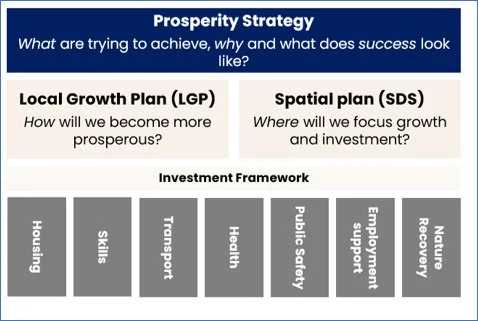
Source: Presentation by Mark Rogers, Interim Chief Executive, Sussex and Brighton Combined County Authority
Delivering the Local Nature Recovery Strategy and the Brighton and Hove Action Plan
The LRNS and the local action plan have established high ideals, and offer exciting opportunities. I set out four proposed themes, tests against which delivery might be assessed:
How will success be measured?
Do we have clear limits to urbanisation and land use intensity?
Will the rules on Biodiversity Net Gain be effective at the intersection of regional priorities with national policy?
Will ecological restoration be delivered beyond the confines of nature reserves, and deliver land management sympathetic to climate and carbon outcomes?
How will success be measured?
Ecological restoration on the ground in Sussex will need to be deployed at scale to deliver new habitats, representing additionality in climate action and carbon abatement, and progress will need to be quantified.
As an example, climate mitigation via carbon sequestration is possible in the enormous range and variety of high biomass ecosystems in Sussex.
Carbon sequestration via bringing ecosystems into diversity creates immense possibilities to restore ecosystems, taking off biomass for use. These measures could benefit wildlife via ecological restoration, which has the added benefit of nutrient cycling and creating biomass which can be a resource for human activities:
Grazing marshes, seasonally used for low-intensity pasture, but also a wetland which sequesters carbon in peat;
Chalk grasslands restored, with lands grazed or cut, with cuttings removed for a range of uses, which could include biomass pellets;
Kelp forests, and their rich fauna, which not only create a vibrant ecosystem themselves, but also sequester carbon;
Regenerative woodland management via coppicing and selective extraction;
It is worth noting that the LNRS focuses on conserving wildlife up to the shoreline boundary: but there are important opportunities synergistically to protect wildlife and sequester carbon. A Blue Carbon Inventory for the United Kingdom, developed for the Wildlife Trusts, WWF UK and the RSPB, found enormous potential for carbon sequestration, further to the existing storage in kelp beds, intertidal seaweed (macroalgae), saltmarsh and seagrass beds named collectively ‘coastal vegetated blue carbon habitats’. 244 Mt of organic carbon (OC)2 is estimated to be in long-term stores across UK seas, in seabed sediments.
In general, therefore, we therefore need to see measurement and surveys to demonstrate recovery of wildlife with biodiversity indicators. This will apply to site-specific actions, to ecological restoration, and to carbon sequestration.
2. Do we have clear limits to urbanisation and land use intensity?
Land use is key to the competing policy objectives associated with climate action. A useful conceptual lens starts with two questions:
How much urbanisation of Sussex is sustainable and desirable for citizens and communities, and how is space for wildlife and landscape created?
How do regions like Sussex achieve large-scale ecosystem restoration, above community-level habitats, and how do we make this socially acceptable and effective?
What might the answers to these two questions look like in practical terms? This is to be debated with citizens, but for example, could include:
Challenge the land encroachment, or urban sprawl associated with out-of-town facilities, be they golf, sport, shopping, medical, school.
Encourage people back into urban areas and regenerate the towns from within.
Enhance train and bus services to reduce the need for private car use: not only on timetabling grounds, but also on cost, reliability, timeliness, cleanliness and tackling anti-social behaviour. This supports climate and nature action, given the carbon reduction in private transport emissions, but also in reduction in wildlife casualties on the roads.
Bring Sussex ecosystems into sympathetic ecological management. This creates opportunities for climate action via carbon sequestration, as above. A positive added benefit over time is an enabling environment for measures by authorities. As an example of where climate action has been opposed by citizens, proposals for a new bus lane in Eastbourne were controversial. It might be argued that this was somehow ‘imposed’ on a population desensitised to nature, environment and climate, and therefore invited huge opposition.
I have set out elsewhere one vision for nature conservation from Eastbourne to Brighton. This is a narrative for nature conservation, but such visions require socio-economic analysis and a route to implementation to make them a reality. In principle, delivery of the LNRS will transcend existing protected areas and stem the tide of new development on greenfield or nature-rich brownfield sites, delivering benefits for wildlife and climate outside of the current approach to site-based conservation.
3. Will the rules on Biodiversity Net Gain be effective at the intersection of regional priorities with national policy?
It will be important for Sussex to be cognisant of the national context in developing understanding of nature conservation policy and its impact on climate action.
At the national level, much emphasis has been put on progress on nature-friendly development policy. Wildlife and Countryside LINK, the umbrella body for the wider conservation network, working closely alongside the Wildlife Trusts, National Trust, RSPB and others, have lobbied for nature protections to be maintained in planning and land use policy, and specifically have advocated closing the loopholes in Biodiversity net Gain (BNG) for small sites. On this, see Emma Montlake’s Review for Climate:Change. Developers can submit a series of smaller, incremental development proposals to remove the requirement for any net gain at all. Closing the loopholes is critical if BNG is going to work for wildlife. Specifically, LINK outline how:
Some proposed BNG exemptions have already been reduced or removed; and
Major infrastructure projects will soon fall under BNG rules
But loopholes have been allowed to continue:
Many larger developments are using exemptions designed for tiny projects - the de minimis loophole;
86% of residential planning applications claimed BNG exemptions in the policy’s first year; and
A land area the size of Manchester is being lost to development annually without meeting biodiversity obligations.
What can be missed in debates on nature is that new land encroachment releases carbon as new infrastructure is constructed. Up to 40% of UK greenhouse gas emissions are linked to the built environment, including heating, operational energy, and construction. Notably, the Environmental Audit Committee (EAC) has called for Whole-life Carbon Assessments, with recommendations for mandatory, regulated assessments of both embodied and operational carbon for all new construction in the UK.
Given the pace of house-building nationally, Wildlife and Countryside LINK and its network are seeking an integration of wildlife protections, with outcomes for both nature and development. In Sussex, the pace of development of housing and associated infrastructure on the ground is rapid. Local authorities have made commitments to climate action, via declarations on net zero and similar, but delivery of such commitments has not held back some of the more imposing peri-urban developments.
4. Will ecological restoration be delivered beyond the confines of nature reserves, and deliver land management sympathetic to climate and carbon outcomes?
The challenge for nature and climate policy is intensely practical: managing implementation and enforcement, and overcoming perceived and real divergence between stakeholders. However, delivery, and outcomes on the ground will fall to local authorities. Authorities are stretched financially, but also in terms of a vision for reconciling competing objectives. The test will come whether space for wildlife can be found outside of the site-based nature reserves, and whether action can be taken to stem human impacts on wildlife.
In terms of electoral politics, in the Sussex Weald, the risk for legacy political parties is that voters are driven away, following large-scale encroachment of housing onto farmland, loss of nature, and the lack of public services to meet new demand.
We might hypothesise that a healthier population, connected to nature, might simultaneously be:
More connected to nature with their own wellbeing enhanced;
Less likely to: oppose transformative change, climate action, select a protest vote;
And that this might provide local political stimulus for environmental actions
Those speaking for nature and those speaking for climate action may be separate and atomised: groups may have limited resources to engage across climate and nature, and there may be limited understanding or knowledge of opportunities among some groups. In Sussex, however, active efforts are in train to link climate and nature discussion: SCAN is an example.
We can hope, therefore, that the new strategies will have created an enabling environment for climate action measures by local authorities. There are win-wins, if society places higher priority on wildlife, and asks how to conserve and restore nature, while also achieving climate and social objectives.
_________
Julie Bygraves is a public policy analyst and consultant. She blogs about Sussex wildlife and landscapes on Instagram at: wildbourne_ebn.
Perspective pieces are the responsibility of the authors, and do not commit Climate:Change in any way.