
Book Review. Indicators of Global Climate Change 2026
Simon Maxwell
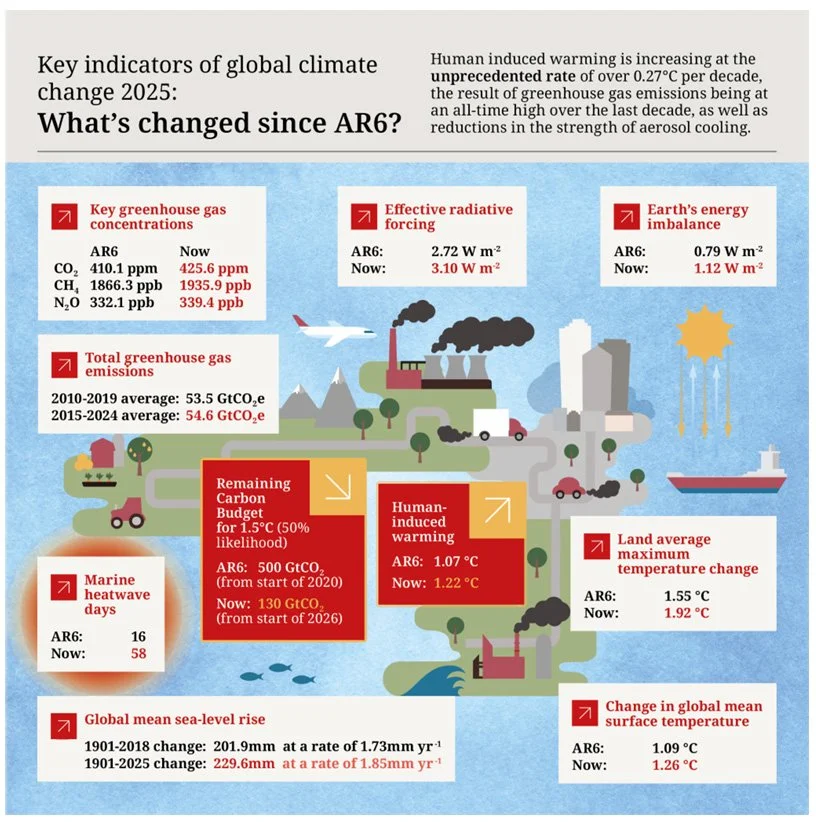
The indispensable annual review of climate indicators by Piers Forster and colleagues was published at the end of April. It confirms the findings we have recently reported, that CO2 emissions are rising, ditto temperatures, sea level, and the frequency of storms. Figure 1 provides an update of changes in key indicators since the publication of the sixth cycle of assessment reports by the Intergovernmental Panel on Climate Change, which culminated in 2023. The abstract of the paper is pasted in at the end of this Note, for ease of reference.
Figure 1
Source: https://essd.copernicus.org/preprints/essd-2026-287/essd-2026-287.pdf
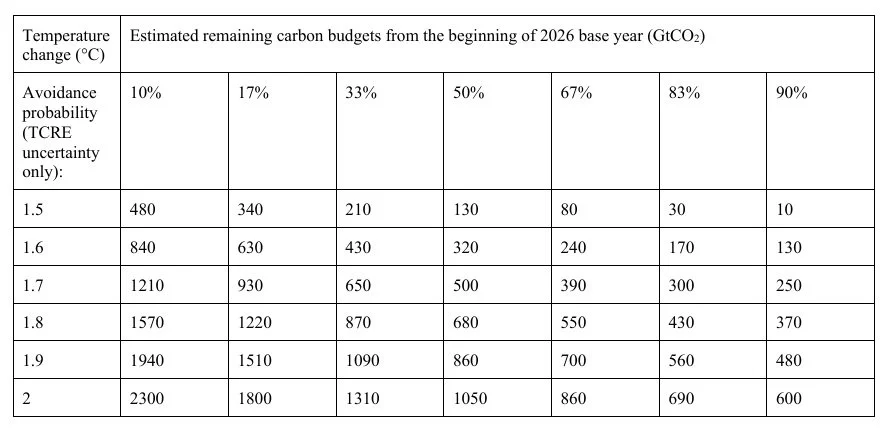
An especially poignant table in the Forster et al paper reports the remaining carbon budget for the different temperature targets in the Paris Agreement – see Table 1. We have reported on previous editions of this table, focusing on the diminishing budget to hold warming to 1.5 degrees with 67% probability. The budget has now fallen to 80 Gt from 1 January 2026, and with current CO2 emissions running at 42 Gt p.a., this budget runs out in 2027. For 2 degrees, there is more leeway: the budget is 860 Gt, which at current rates would last for 20 years. Note, however, that all these estimates assume reductions in methane and other non-CO2 pollutants, which have not been realised: the budgets need to be reduced accordingly.
Carbon budget remaining from 1 January 2026
Source: https://essd.copernicus.org/preprints/essd-2026-287/essd-2026-287.pdf
___________
Abstract
In a rapidly changing climate, evidence-based decision-making benefits from up-to-date and timely information. We track twelve key sets of indicators of the state of the climate system, closely following Intergovernmental Panel on Climate Change (IPCC) Sixth Assessment report (AR6) methods, to produce our fourth annual publication. One of the indicators, the Earth’s energy imbalance (EEI) provides a crucial integrative measure of the pace of climate change – this has more than doubled since the 1976-1995 period. A newly updated indicator of temperature extremes, the number of days experiencing marine heatwaves, has more than tripled between 1991 and 2025.
For the 2016–2025 decade average, observed warming relative to 1850-1900 was 1.26 [1.13 to 1.36] °C, of which 1.24 [1.0 to 1.5] °C was human-induced. Human-induced warming reached 1.37 °C relative to 1850-1900 in the year 2025, increasing at a rate of 0.27 [0.2 - 0.4] °C per decade over 2016-2025. This high rate of warming, which matches the all-time high seen last year in the instrumental record, was caused by a combination of greenhouse gas emissions being at an all-time high of 54.6 ± 5.5 GtCO2e per year over the last decade (2015-2024), as well as reductions in the strength of aerosol cooling. Despite this, there is evidence that CO₂ emission growth is slowing. The continuation of these annual updates could track decreases or increases in the rate of human influence and climatic changes presented here, reflecting the outcomes of societal choices during the critical 2020s decade.
In total, we employ analysis from over 40 global datasets (https://doi.org/10.5281/ZENODO.7883757 Smith et al., 2026a) These data are threatened by geopolitical and public funding decisions that are cutting support for key satellite and in-situ observing programs critical for the monitoring of the atmosphere, ocean, cryosphere and land surface, including long-term data preservation and provision that is key to understanding our changing climate for today and for future generations. Overall, the Global Climate Observing System (GCOS) framework, which supports much of our international capability, is under threat. Our ability to monitor effectively many of the indicators presented herein is not guaranteed without concerted international action to ensure the continuity of observation programs and coordination mechanisms, including the GCOS program, that enable their effective integration and use.
Source: https://essd.copernicus.org/preprints/essd-2026-287/essd-2026-287.pdf
Simon Maxwell is Co-Chair of Climate:Change
Perspective pieces are the responsibility of the authors, and do not commit Climate:Change in any way.