
Briefing Paper: How to integrate different energy efficiency standards
Briefing Paper: How to integrate different energy efficiency standards
Kiro Tamer
Key points
There are multiple frameworks for assessing and reporting on energy efficiency - EPC, ESOS, SECR, CRP and NABERS are considered here ;
While all have their place, there is significant overlap in data requirements, and hence potential for integration;
Furthermore, a critical problem is the ‘delivery gap’: achieving compliance does not guarantee a reduction in actual energy demand;
An integrated approach can overcome the delivery gap, increasing energy efficiency, and saving time and money.
One of the best known and most common energy efficiency certifications for domestic and commercial buildings is the Energy Performance Certificate (EPC). An EPC is a mandatory requirement of the Minimum Energy Efficiency Standard, and it applies to domestic and commercial buildings which are either sold or rented. It covers energy usage, lighting and heating/hot water costs, provides an energy efficiency rating from A to G, offers recommendations for reducing energy usage, and gives the property's Environmental (CO2) impact. EPCs are publicly available via a Government website.
However, there are several other frameworks, some legally mandated, designed to challenge and support organisations and businesses to carry out energy audits, report their carbon performance, and set Net Zero targets. These are mainly focused on large organisations or those tendering for public contracts larger than £5M. These other frameworks are:
a. ESOS (The Energy Savings Opportunity Scheme);
b. SECR (Streamlined Energy and Carbon Reporting);
c. CRP (Carbon Reduction Plan); and
d. NABERS UK (National Australian Built Environment Rating System).
The main features of these different frameworks are summarised in Table 1 (also available here as a pdf).
Table 1
Main features of UK energy efficiency frameworks
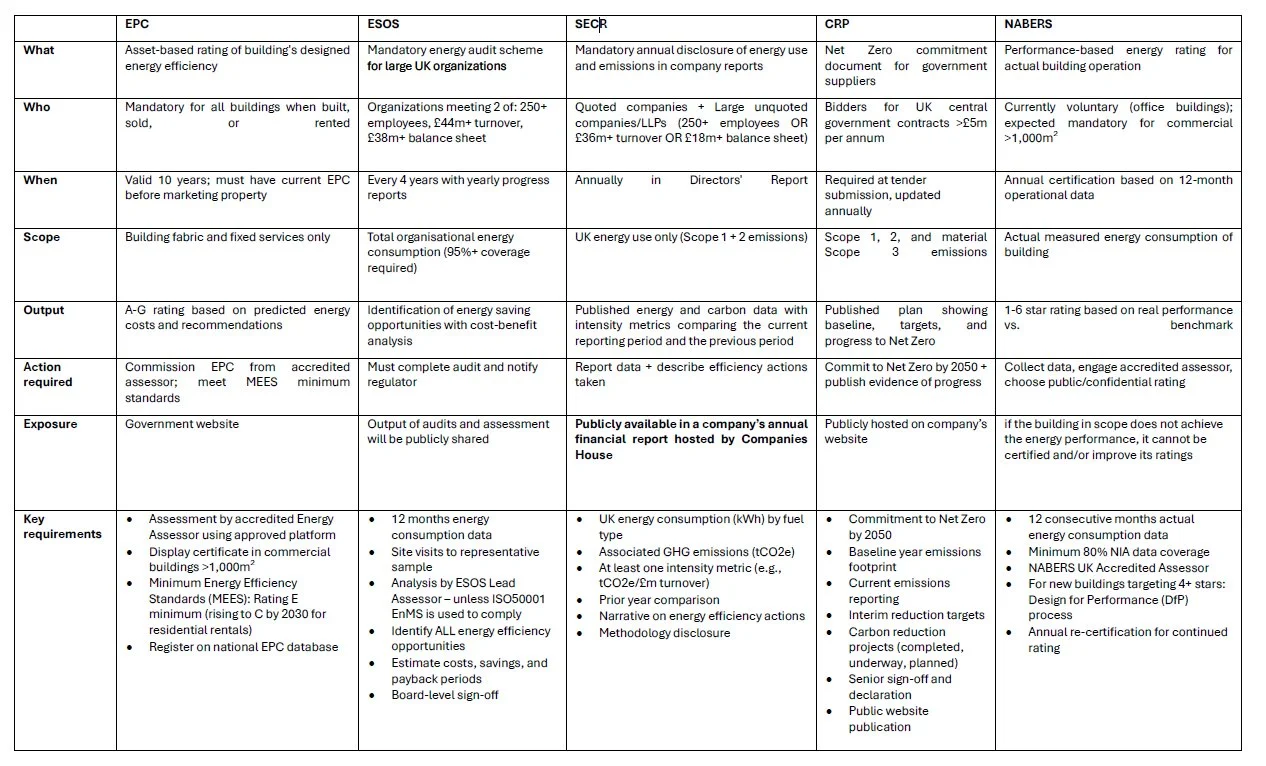
Note forthcoming changes to EPC requirements. For residential properties, landlords will not be able to rent a property with a rating lower than C by 2028 for new tenancies, and by 2030 for all existing tenancies. For commercial properties, the bar is higher: a minimum EPC rating of C is required by April 2027, rising to B by April 2030. The government’s proposed residential MEES changes include a cost cap of up to £15,000 per property, representing the maximum a landlord would be required to spend to improve their EPC rating in order legally to continue letting the property. For many landlords — particularly those with older housing stock — this represents a significant financial burden, and there is a real risk that some will choose to exit the rental market rather than invest in improvements, potentially reducing the supply of available rental properties.
The foundations of these regulations and schemes are similar, measuring energy efficiency and identifying ways to increase the efficiency of the building and/or organisation. For example, apart from EPCs, all require annual consumption data to be measured and reported.
Despite similar foundations, the different regulations play different roles to satisfy specific requirements:
EPCs advise a potential buyer or lessee how energy efficient the property is;
ESOS drives energy audits with specific outputs which require board level report sign off;
SECR requires companies to report their energy and carbon performance in their annual financial report;
NABERS requires participants to make energy efficiency improvements to gain or improve the certification rating;
Whereas ESOS, SECR and CRP, do not provide a single way of delivering the requirement, EPCs do provide a more structured procedure to follow and output to generate.
A critical problem is that achieving compliance does not guarantee a reduction in actual energy demand. An organisation or landlord can satisfy the regulatory requirement on paper — obtaining the necessary certificate or submitting the required report — without making any meaningful improvement to the energy performance of the building or operation. The gap between compliance and genuine energy reduction is one of the most significant weaknesses of the current regulatory framework. Thus, MEES was first introduced through the Energy Efficiency (Private Rented Property) Regulations 2015, with enforcement beginning April 2018. ESOS was first introduced in 2014, yet despite almost a decade of regulation, there are many buildings which do not operate efficiently.
Integrated analysis can help overcome the ‘delivery gap’. The tools, processes and mechanisms for collecting and reporting energy demand, reviewing energy-using processes, quantifying energy efficiency and converting/calculating to carbon equivalent are readily available, tested and proven, and can be applied to all energy using processes. See the two case studies in Boxes 1 and 2, illustrating the benefits of an integrated approach.
Box 1
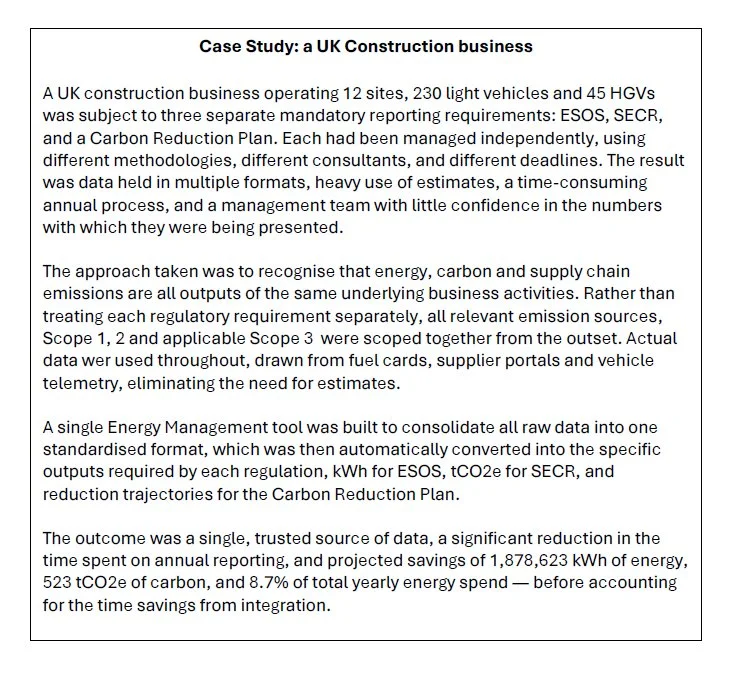
Box 2

Therefore, while the regulations/schemes may play a slight different role and serve specific requirements, there are many lessons and mechanisms which can be adopted to support the effectiveness and quality of assessments, which will not only reduce the burden of the data collection, but will hopefully also build the skill sets and trust in the relevant technologies or methodologies. There are also clear opportunities for organisations in the public and private sectors to simplify and change the approach to move away from compliance and drive energy efficiency.
___________________
Kiro Tamer has a BEng in Energy Engineering for Sustainability and gained his ESOS Lead Assessor Qualification in 2015. In 2024, he established KEES, an engineering led sustainability consultancy.
Perspective pieces are the responsibility of the authors, and do not commit Climate:Change in any way. Comments are welcome.