
Briefing Paper: A Strategic Energy Partnership: Lessons for Brighton and Hove from Bristol City Leap
A Strategic Energy Partnership: Lessons for Brighton and Hove from Bristol City Leap
Colin Nolden
Summary
Brighton and Hove is considering entering into a Strategic Energy Partnership to accelerate investment in its £2.6bn decarbonisation programme.
Bristol has pioneered this approach, via its Bristol City Leap public-private-partnership, providing preferential contract opportunities, in return for investment and social value.
There are significant advantages to aggregating a diverse range of decarbonisation projects, bringing in new investment, reducing transactions costs, and accelerating delivery.
There is potential for significant social value generation by cross-subsidising less profitable projects, building local supply chains, providing a social fund, and supporting the local community energy ecosystem.
However, contract design and management are both critical, and require significant public sector contract management experience and expertise.
Scale matters in terms of attracting good quality bids among potential contracting partners.
Contracts need to be designed and projects managed so that community energy entities are not crowded out.
What Brighton and Hove is planning
Brighton and Hove is exploring the idea of setting up a Strategic Energy Partnership, to accelerate investment in decarbonisation of the City – and is testing the market through a process of Preliminary Market Engagement. Full documentation is available on the Council website, including a Prospectus and full information document.
The objective is to accelerate decarbonisation of Brighton and Hove’s energy system, with investment needs estimated at £2.6bn, covering retro-fitting of domestic and non-domestic buildings in the City, new district heat networks, a rapid roll-out of rooftop solar, and EV charging. See Figure 1.
Figure 1
Summary of Brighton and Hove Decarbonisation priorities
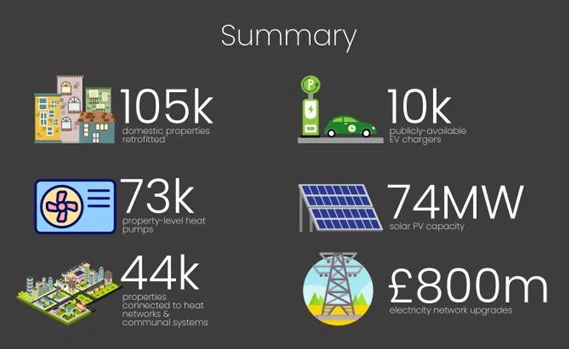
Brighton and Hove envisages a partnership model, as summarised in Box 1. This is essentially a framework contract, with commercial benefits for partners, but with the Council retaining overall strategic control. There is an emphasis on profit-sharing and on community value, including via the development of local supply chains.
Box 1
Brighton and Hove envisioned partnership model
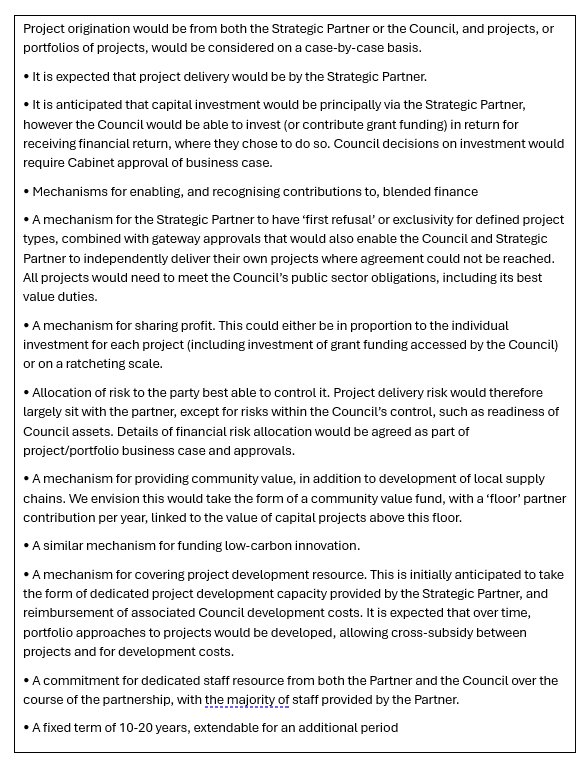
Source: https://www.brighton-hove.gov.uk/sites/default/files/2026-02/Preliminary%20Market%20Engagement%20Information%20document.pdf
Bristol City Leap
The history
Brighton and Hove is not the first City to go down this path. Bristol City Leap is the pre-eminent case. So what lessons can be learned, and what pitfalls should be avoided?
Up to 2018, Bristol City Council (BCC) pursued a model which maintained 100% control of its assets. In the previous ten years, it invested around £100m in decarbonisation projects which were delivered by BCC’s energy services team. Consisting of about 35 people, it had expertise in large-scale renewable energy projects, heat network expansion, energy efficiency improvements, grant administration, and advice for tenants
The approach amounted to a ‘drip feed of delivery in terms of decarbonisation based on… what budget the Council had available to put into it’ (BCC rep). To decarbonise the City, however, a significant increase in scale and pace was needed.
In 2018, two members of BCCs energy service team put together the City Leap prospectus. Following cabinet approval and a pittance (around £10k) in support of their efforts, they engaged in soft-market testing in 2018. To their surprise, they received nearly 200 expressions of interest. Over several ‘pretty gruelling few months’ (BCC rep) they met with around 160 of them. The proposals ranged from models entirely owned by the contractor (often referred to as energy service contracts) to partnership models (often referred to as relational contracts, see Table 1).
Table 1
Spectrum of governance structures for city decarbonisation
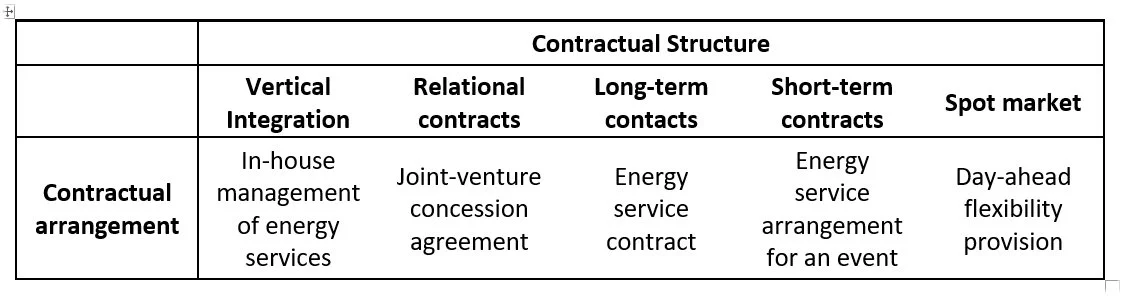
Source: https://link.springer.com/article/10.1007/s12053-025-10346-w
Energy service contracts would have involved buying BCC out of all their assets, which would have delivered a very short-term profit for BCC. But most organisations they engaged with were interested in a joint-venture concession agreement. At this stage, the team brought in some external commercial expertise for the full options appraisal, to make sure the proposals most grounded in reality and with the best business sense were presented to cabinet.
The recommendation put forward was to seek partnership with an organisation or a consortium of organisations through a long-term joint-venture concession agreement (relational contract) without a specific percentage point of ownership to:
Ensure the contractor takes on both risk and reward
Create an outward facing entity (which is unusual within conventional procurement arrangements)
Transfer BCC’s energy service team to the joint-venture company
Sell the district heating network
Award strategic control of operations to the joint-venture company to minimise future political interference and allow it to operate beyond the constraints of public procurement legislation
Features of the Bristol model
The Bristol City Leap agreement commits the winning consortium, comprising Ameresco together with Vattenfall as an essential subcontractor, to invest around £424m in the first five years with a total investment volume of nearly £1bn over 20 years according to a series of Key Performance Indicators (KPIs). It has been summarised and reviewed here. Quotes below are from that research.
The way assets are included in any concession agreement determines what kind of consortia will bid for it. Bristol City Leap involved the sale of the heat network at cost price. Additionally, BCC had a Local Development Order (LDO) in place which granted any developer of heat networks permission to install heat networks. Alongside, Bristol’s Heat Network Zone included mandatory connections. Specific building types within these zones, including large non-domestic buildings such as hospitals, universities, and offices were required to connect, thereby creating a captive market which was deemed necessary to make commercially attractive returns.
While BCC retained ownership of the all the other assets (wind turbines, solar PV systems etc.), the concession agreement involved the transfer of most of BCC’s energy service team to Bristol City Leap. This was seen as
‘a huge risk, especially if you’re managing a really big energy contract…. So we left a couple of members of staff behind, who were… colleagues tasked with the Council’s energy procurement, so looking after… energy contracts and paying bills for the gas and electric essentially … and some commercial capability as well. So [Bristol City Council] formed a new team called client function. They work between Bristol City Leap and Bristol City Council to make sure that not only [is Bristol City Leap] held to account in terms of all the things that [Bristol City Leap] said contractually that [Bristol City Leap] would deliver, but also that the Council is held to account in all the things that they said that they would do to enable [Bristol City Leap] to deliver, to make sure that [Bristol City Leap] remained looped into those key services within the Council and that [Bristol City Leap] have… a single point of contact to enable [Bristol City Leap] to deal with things [Bristol City Leap] need to do’ (BCC rep).
A core feature of the Bristol City Leap concession agreement is the ‘first refusal’ regarding Council projects on the Council’s estate. Effectively, the ‘first refusal’ mechanism within concession agreement implies that Ameresco (together with Vattenfall) are pre-procured partners. If BCC wants to have a Council-owned tower block retrofitted to EPC B, Ameresco has the ‘first refusal’ to do so without the need for a public tender. This accelerates the process by lowering the transaction costs involved. It also presents the greatest risk (Nolden et al. 2025).
Among the contractual mechanisms to ensure that the BCC ‘didn’t end up with the private sector just […] cherry picking’, for example, saying ‘we’re only going to do heat networks for the next 20 years’ (BCL rep), the social value framework stands out. According to a competing bidder,
‘To put together the programme in a smart way that effectively it's like if the smaller projects or lower return projects were delivering more social value you then set a social value requirement that meant you had to do the nice fat juicy project but also the social value projects in order to hit your metric and you can see that the private sector understands that, they would see that that's a legitimate ask. If the smaller projects, the ones with the social value were rubbish, were crap projects being done for vanity, that would be different. But [the contractors] sort of get that the government or the public sector has multiple objectives they're trying to hit in that sort of framework’ (competing BCL bidder)
14.4% of the initially contracted £424m of investment (£61m) are for social value. While exact details are not available due to commercial sensitivity, it is evident that the most significant social value component is contracts with local suppliers.
Table 2:
Social value in the Bristol City Leap Contract
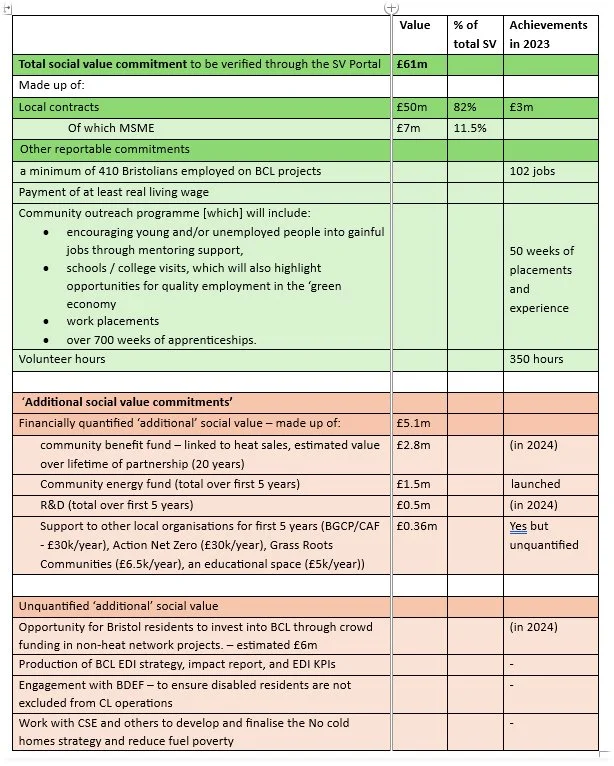
Source: https://www.sciencedirect.com/science/article/pii/S2214629626000423?via%3Dihub
The way social value has been contracted as part of the Bristol City Leap concession agreement is therefore considered a means of holding Ameresco and Vattenfall to account.
Some lessons from Bristol City Leap
Combined, the (controversial) sale of the heat network at cost price, the LDO and mandatory connections, and the ‘right of first refusal’ are the key elements of Bristol City Leap which made it attractive to private sector investors. Some other issues include:
Scale
While it is too early to determine the success of the approach, the overall scale of the agreement appears to be a key factor in creating the opportunity to engage in dialogue with contracting partners in the first place. This has enabled the development of a meaningful social value strategy that can effectively be monitored and accounted for.
‘EOn got picked [as strategic energy partner in Coventry]. I think the impression we sort of got was that it wasn't big enough like Bristol that you could really develop some proper dialogue. It was a bunch of projects and EOn being local and in place really wanted to win that and could, maybe what I guess is quite a low working capital charge, I’ve got no knowledge, but I imagine kind of effectively you could bid your business development activity for free because you're doing it if it's in your local patch, that sort of style. Whereas if it had been twice the size or so, other bidders would have developed something really bespoke for the package and might well have found there was a better competition. So that's the sort of challenge that's there in that middle. So that's why the Bristol City Leap has this attraction of being big enough to be tailored and therefore likely to succeed’ (competing BCL bidder)
Scale is therefore important in ensuring that there is competition among bidding consortia and in ensuring commitment to long-term social value generation and amplification.
The capacity to manage contracts
What needs to be taken into account is also the sometimes (but not always) dismal track record of public-private partnerships in the UK. Public finance initiatives (PFIs) in particular have received a lot of attention for in some prominent cases delivering infrastructure investments at much higher cost than originally anticipated. Retaining sufficient procurement and contractual capability within the Council to maintain oversight, monitor risks, and, if necessary, trigger contractual mechanisms within the Council is therefore crucial.
‘A lot of the district heating schemes are done through special purpose vehicles. So joint risk of setting up a new organization that is partly owned by the private sector to try and get away from that privatization of profit and nationalization if you like of risk which generally public private partnerships are seen to be that if there's any money to be made it goes one way and if there's any risk it goes the other. Within our world, I think we're not exploring within the UK enough about community ownership. Generally, I think probably it works on a smaller scale. It wouldn't work for something as big as Bristol City Leap, but it could potentially work for renewables projects. It would help keep some of that profit in the local hands.’ (Former Energy Service Company rep)
BCC retained five people in their energy service team which now serves as the client function overseeing delivery of Bristol City Leap.
Ownership and the role of community energy
While it is widely recognised that the scale and associated risk of energy system investment required to decarbonise cities such as Bristol or Brighton and Hove requires commercial expertise and leadership, the final ownership model of the entity in charge of largely decarbonised and paid-for energy systems does not need to be commercial (profit maximising).
‘Whether that ultimately should be owned by the city Council, whether it should be owned by combined authorities, whether it should be owned by cooperatives… or local people, local businesses, I don't know what the best model is for that if I'm honest, but I think that expanding that community ownership model to find ways where it can work on a bigger scale may be the way to do it’ (Former Energy Service Company rep)
Bristol, like Brighton and Hove, benefits from a mature community energy ecosystem. Bristol City Leap includes a £1.5m community energy fund to support it but there is a sense of ‘crowding-out’ among groups in Bristol and surrounding local authority areas as Bristol City Leap is seen as capitalising on its scale and the public sector support it receives.
Lessons for Brighton and Hove
The Bristol model was deemed the most suitable for Bristol but in different circumstances different business models might be more appropriate:
‘The Council won’t always be able to bring capital to the table, but there’s a range of sort of co-benefits that they can bring, that no other organisation could, and that makes it a very attractive partner in that regard… You need to really think about your own proposition because there will be nuances across different towns and cities and… local authority areas depending on if it’s more of a rural, or more of an urban community, what existing assets there are… Bristol is... very blessed in that we had an existing set of low carbon energy infrastructure assets already up and running in the city so the Council… had built and was operating its own wind turbines and had its own solar farm, most of the… offices and commercial estate for the Council had some form of solar on them’ (BCC rep)
Taking this into account, there are some valuable lessons for Brighton and Hove, and some things to think about.
First, there are significant advantages to aggregating a range of decarbonisation projects, bringing in new investment, reducing transactions costs, and accelerating delivery.
Second, there is potential for significant social value, by cross-subsidising less profitable projects, building local supply chains, and providing a social fund.
Third, however, contract design and management are both critical, and require significant public sector contract management experience and expertise. Different contract models need deep understanding, and very careful management is required if contracts are to succeed for all parties.
Fourth, scale matters in terms of attracting the right kind of outside partner.
Fifth, contracts need to be designed and projects managed so that community energy entities, experienced and effective at local level, can make their contribution and are not crowded out by commercial interests.
_______________
Colin Nolden is a Senior Research Fellow at the Energy Institute and Management School of the University of Sheffield.
Perspective pieces are the responsibility of the authors, and do not commit Climate:Change in any way. Comments are welcome.