
Review. The Copenhagen Way: seven lessons for climate compatible development in Brighton and Hove
Simon Maxwell
The Copenhagen Way
Start with this, from the Executive Summary of a new report, the Copenhagen Way, about the thirty-year transformation of Copenhagen:
‘It is hard to imagine today, but in the early 1990s, Copenhagen was a city in decline. Its population was shrinking, unemployment was high, housing was outdated, and the municipal budget was on the verge of collapse. Three decades later, it ranks as the world’s most liveable city and one of Europe’s most competitive urban economies. This transformation shows that systemic change is possible within a generation when long-term vision, institutional innovation, and cross-sector alliances come together.’
That is intriguing. What is the secret? The Executive Summary continues:
‘Renewal programmes first improved housing and later evolved into holistic regeneration of entire neighbourhoods, bringing residents directly into the process. Long-term municipal planning provided direction and continuity, sequencing growth and infrastructure in ways that kept the city coherent and enabled investments. Significant investments became turning points. The metro and harbour redevelopment, financed through land value capture and impressively delivered by Copenhagen City and Port Development (By & Havn) with pension funds, turned urban infrastructure into an engine of growth. The city’s year as European Capital of Culture in 1996 embedded culture as a driver of identity, innovation and competitiveness. The Øresund Bridge expanded the labour and housing market across borders, while initiatives like Medicon Valley and Science City created powerful knowledge and innovation ecosystems.
Climate ambition was not treated as a cost but as a foundation for progress. The Eco-Metropolis plan, the 2025 Climate Plan, and the Cloudburst strategy integrated decarbonisation and adaptation into how the city was built and lived in. . .
What emerges is a clear lesson. Transformation was not about one-off projects but about consistent ways of connecting direction with delivery and aligning actors around common goals with a holistic investment toolkit. . . The city’s trajectory has been neither accidental nor linear. It has been the result of one coherent, long-term, cross-sector effort. A culture of co-responsibility, planning as learning, and with policy direction maintained across election cycles.’
Summarising the Copenhagen Way, the Report identifies 6 features of the approach (Box 1).
Box 1
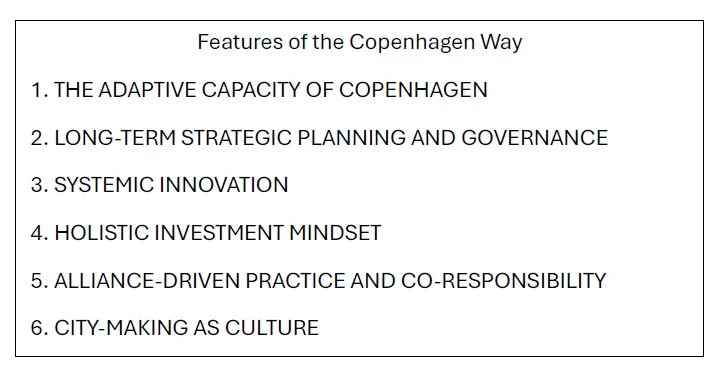
At first sight, these appear bland, but there is more detail in the ‘Key Action Points’. There are 12 of these, focused on delivering a competitive and liveable region, which is also climate compatible:
A competitive and liveable region
Urban renewal. ‘Inadequate housing quality and size, combined with the modernist ideal of the good life outside the city, had already led many residents to relocate to emerging suburban areas. As a result, the city’s demographic composition was dominated by students and elderly residents, who contributed relatively little to the municipal tax base . . . Initial steps to counter this situation began with a comprehensive urban renewal strategy . . . (but) it became clear that improving the physical condition of the housing stock alone was not enough to address the city’s growing challenges. In response, the initial strategy evolved, and the government launched (a new) initiative (which) emphasised holistic planning, cross-sector partnerships, citizen involvement, and public–private collaboration. Supported by the Ministry of Housing, it enabled municipalities and local organisations to implement long-term, community-driven projects.’
The municipal plan. This was a 12-year vision, transcending political cycles. ‘Essential to the plan was its integrated approach to urban development. It was not just a land-use plan, but a holistic framework that considered housing needs, economic development, environmental quality, and transport.’
Regional expansion. This included the bridge from Copenhagen to Malmo in Sweden, and gradual integration of the port facilities and wider economies of the two regions.
Infrastructure-guided development and land value capture. ‘In brief, the partnership and land-value-capture model worked as follows: the state and city transferred public land, typically former industrial sites, to Copenhagen City & Port Development; the city rezoned the land, raising its value; the company borrowed against that value to fund the metro and other enabling infrastructure; and it then sold or leased plots to developers, using the proceeds to service the debt.’
Revitalisation of Copenhagen Harbour. ‘Building on the land value capture model, the harbour project applied the same financial principles to a far broader urban agenda. At the heart of this process is By & Havn, a state- and municipally owned but independently operated development corporation . . . Large-scale redevelopment has often been organised as joint ventures between By & Havn and Danish institutional investors, particularly pension funds . . . In these arrangements, By & Havn typically contributes serviced land and planning expertise, while pension funds provide long-term capital and development capacity. This model spreads risk, ensures financial stability over decades-long build-outs, and enables the coordinated delivery of housing, offices, public spaces, and infrastructure in complex, multi-phase districts . . ‘
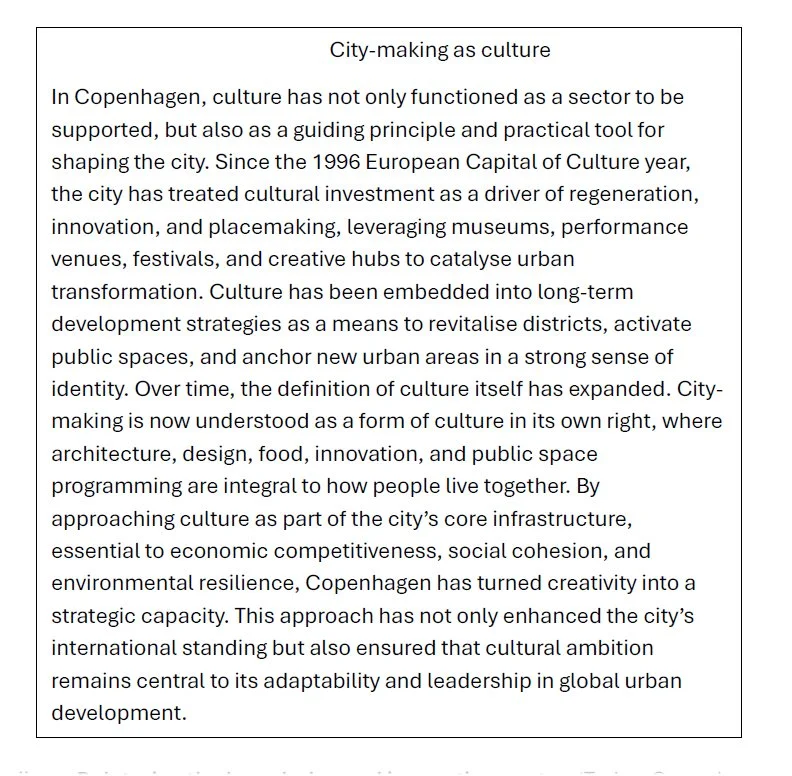
Building cultural capacity. ‘Recognising the value of creative talent and cultural capital in strengthening urban competitiveness sparked a growing interest in expanding Copenhagen’s cultural sector. A strong cultural foundation was seen not only as a source of attraction but also as a driver of economic and social vitality.’ See Box 2.
Box 2
Bolstering the knowledge and innovation sector. ‘Today, Copenhagen ranks among the highest-performing innovation cities in several international indexes. This position has been achieved through a variety of partnerships, policies, and grants designed to strengthen specific innovation sectors and promote closer collaboration between countries, institutions, industry, and the city.’
Holistic urban renewal. ‘As the city progressed with its urban renewal efforts, the legislative frameworks gradually shifted focus from the physical upgrading of individual buildings to a more integrated approach centred on the renewal of entire neighbourhoods and public spaces. The frameworks increasingly emphasised reinforcing synergies between the various actors involved and promoting partnerships among civic, institutional, private, and governmental stakeholders.’ There was a significant spillover effect: ‘Between 2006 and 2011, for every 1 krone of public investment in urban renewal in cities, private homeowners invested 2.4 kroner. The private investments supported not only building restoration but also local businesses and neighbourhood amenities.’
Liveability. ‘The focus on human-centred development has been an integral part of Copenhagen’s urban transformation since the 1990s. Key efforts, such as urban renewal, harbour cleaning, the expansion of cycling and pedestrian-friendly infrastructure, and the revitalisation of public spaces, gradually positioned Copenhagen as a city recognised for its commitment to people-oriented urban planning.’
Climate action
Eco-metropolis. The Copenhagen climate plan was launched in 2007. Alongside emission reduction targets, a primary objective was to position Copenhagen as a green and blue capital. By 2015, the goal was for 90 % of residents to be within a 15-minute walk of a park, beach, or swimming area, driving the transformation of urban spaces into pocket parks and the creation of new recreational zones, such as beaches and harbour baths. Mobility was another core pillar. The plan aimed for 50 % of all commutes to work or school to be made by bicycle, and to reduce serious cycling injuries. Other actions included retrofitting municipal buildings to cut energy use, addressing air and noise pollution, and promoting ecological solutions.
Climate Plan. A new plan in 2012 ‘aimed to achieve green growth by showing how the green transition could align with economic development and improved urban quality of life. It specifically sought to leverage decarbonization efforts to create jobs, drive innovation within the sector, improve public health, and enhance the overall quality of the urban environment. The city utilised its regulatory and coordinating powers to guide the process, for example, by establishing new municipal building codes and standards, and by funding a range of pilot projects.’
Adaptation. Finally, the City acted on adaptation, especially the impact of cloudbursts. ‘A collaborative model relies on co-financing through municipal taxes and investments from utility companies, enabling shared responsibility and integrated solutions across municipal and utility systems. . . Since 2011, the city has initiated around 300 blue-green infrastructure projects and major cloudburst tunnels, transforming streets, parks, and courtyards into multifunctional spaces that not only manage rainwater but also provide recreational and ecological value.’
In a last section, the Report provides more detail on specific action related to energy, housing, adaptation, mobility, and planning:
On energy, the City has adopted the sector coupling approach. It integrates electricity, district heating, cooling, and waste streams into a single network. District heating absorbs surplus wind and solar electricity, storing thermal energy for later use. Waste heat flows across industrial clusters and neighbourhoods.
On housing, the key idea is to tackle a critical shortage and housing crisis by developing financial models which treat housing, especially affordable housing, as infrastructure investment rather than speculative investment, thereby attracting long-term investment which is able to accept lower returns in exchange for lower risk.
In relation to adaptation, a change in mindset is required, particularly given the vulnerability of Copenhagen’s large areas of reclaimed land, to integrate hydrology into all aspects of City development and turn water into an investible asset: ‘Current financial models often fail to capture the full value of adaptation, including avoided damage, social benefits, and green job opportunities. Without clear frameworks for return on investment, decision-makers and private actors struggle to prioritise.’ Nature-based solutions are key.
In relation to mobility, the priority is to build on Copenhagen’s success as a cycling city, especially by reducing car ownership. Measures recommended include: reduce private car use through road pricing, higher parking fees, and relocating parking to the perimeter of areas; integrating public transport, cycling, and shared mobility into a single digital platform for seamless multi-modal trips in the centre and outskirts of Copenhagen; plan all new development areas with a mobility vision that prioritises walking, cycling, and public transport, reducing car dependency from the start and enabling a car-free lifestyle; ensure transport investments encourage flexible, multimodal solutions rather than relying solely on the rail effect, so all areas can grow and remain accessible; and apply political courage to implement long-term, consistent mobility policies that shift behaviour, reduce car dependency, and free up space for people.
On planning, the emphasis is on long-term but adaptable strategic continuity. ‘The municipality plays the role of conductor, holding long-term direction, ensuring overall coherence, and maintaining continuity across political cycles.’ Finance is seen as ‘the enabler, not the constraint: . . . the path forward lies in blended finance and de-risking mechanisms, including public & corporate guarantees, conditional access to land, utility co-investment, and lifecycle-based ROI models.’
Lessons for Brighton and Hove
It goes without saying that every City is different, in terms of location, history, scale, and resources. In particular, path dependency plays a big part in the Copenhagen story. For example, the City has social and cooperative housing sectors, dating to the early twentieth century, which account for over half the housing stock: hence the early emphasis on housing improvement in the transformation programme. The district heating model also goes back to the same period, with major expansion from the 1920s on. The availability of former industrial and harbour sites also provided significant opportunities.
Nevertheless, there are plums in the pudding, features of the Copenhagen way that are worth exploring for Brighton and Hove.
First, the emphasis on long-term, holistic, participatory, and strategic but adaptable planning is impressive. A very good example is the integration of spatial planning with economic development and the ‘liveability’ of City neighbourhoods.
Second, the strong focus on sectoral development, especially culture and science/technology, providing Copenhagen with a competitive edge.
Third, the idea of finance as the enabler, not the constraint, especially by making transformation ‘investible’ and attractive to long-term, patient capital. This is most clearly seen in the idea of housing as infrastructure, but also in actual infrastructure, like the bridge to Malmo.
Fourth, the institutional innovation of a City-specific development corporation, By & Havn, working closely with pension funds and other investors, and acting to prepare and de-risk investment.
Fifth, the determined focus on land-value capture, as sites owned by the City are made available to developers, with revenues hypothecated to service investments.
Sixth, the emphasis on a new approach to mobility, not just building the infrastructure for and encouraging cycling, but more generally being willing to tackle questions of how urban space is used and what price car owners should pay for access to it.
Seventh, of course, the close integration of climate action into City transformation, especially with regard to adaptation.
__________
Simon Maxwell is Co-Chair of Climate:Change
Perspective pieces are the responsibility of the authors, and do not commit Climate:Change in any way.