
Briefing Paper. Heat and the adaptation challenge in Brighton and Hove
Heat and the adaptation challenge in Brighton and Hove
Nicky Lumb
Key points
Heat harms Brighton and Hove every summer, mostly on ordinary warm days that trigger no alert, and mostly indoors and unseen — the danger is the warm summer, not the 40°C day.
The city acts from an unusually strong evidence base, but its heat response is not yet costed, funded or given a lasting home — the same gap the Climate Change Committee finds nationally.
There is now a clear picture of what good looks like, and a route to a durable response through the new Sussex & Brighton authority and the National Heat Risk Commission.
Most of what would strengthen the response builds on what has begun, and reaches the people and places the evidence identifies. There are ten recommendations, offered as input to any heat-plan review and potential Heatwave Partnership:
1. Build the summer equivalent of the winter machinery
2. Make cool space a real, year-round network, built on the newly live map.
3. Shade the hotspots the city has already mapped.
4. Press for cooler buses as transport powers.
5. Set a net canopy target where heat and people.
6. Pilot Climate Resilient Schools in the heat-island hotspots.
7. Target the homes that overheat, cooling the right way.
8. Treat heat as a visitor-economy and events risk, with real guidance
9. Apply an equity test, and report.
10. Use the combined authority to give heat a durable, regional.
Introduction
Many see warmer summer days as welcome relief from increasingly wet winters, and as a coastal city dependent on tourism, sunny days bring income and let residents enjoy the benefits of seaside living. But whilst the headlines warn people when temperatures reach new extremes, heat also harms people in this city every summer, at the temperatures the forecast calls pleasant.
Brighton and Hove can name, street by street, where this heat harms and on whom. It has better heat evidence than almost any city its size, and a council that takes adaptation seriously. It has begun to act. This paper asks whether that response is enough for the heat the city already has and the heat to come. Where it falls short, it sets out what would strengthen it — the city’s own levers first, and the regional and national framework it depends on — drawing on London’s first heat plan and on cities further ahead.
Throughout, where the paper says what the Council, the health system, landlords, businesses or residents could do, that is our reading of their published roles and powers, not a commitment any of them has given. It draws on published evidence and the city’s own documents.
A proven, and misread, threat
Extreme heat kills, as 2026 has made very clear.
UKHSA's monitoring recorded 2,877 heat-related deaths in England across the May and June 2026 heatwaves, many of them well before the summer’s headline extremes, and researchers estimate that roughly two-fifths of the heat toll was attributable to human-caused climate change (UKHSA; Imperial/Grantham; Met Office).
Across the Channel it was deadlier still: Santé publique France counted 5,764 excess deaths across the heat episode of 17 June to 2 July, France’s worst since 2003, and Spain recorded 1,029 heat-attributed deaths in June, the deadliest June its monitoring has logged since 2015 (MoMo, Carlos III Health Institute).
2026 went on to be provisionally the UK’s hottest summer on record, peaking at 38.1°C, with five heatwaves and more than 25 days above 30°C. The Met Office logged a provisional England June record of 37.7°C at Lingwood on 26 June (Met Office), and Brighton sat under a rare red heat-health alert — also in June.
The mistake would be to assume that everything below those extremes is safe. It is not. In 2024, a summer with no records and no red alerts, heat was still associated with more than 1,300 deaths in England (UKHSA). Because the UK has far more moderate-heat days than extreme ones, it is this quiet middle band, the ordinary summer, that carries most of the burden. Brighton and Hove’s cool coastline usually spares it the headline extremes, so for this city the danger lies less in the 40°C day than in the warm, unremarkable summer that no one thinks to fear.
And the heat is intensifying at both ends. The Met Office’s State of the UK Climate 2025, published in July 2026, concludes that “the climate of the 20th century has now gone”: 2025 was the warmest year in a series stretching back to 1884, and conditions once thought exceptional are becoming routine (Met Office; Carbon Brief). A summer like 2025 would have been roughly a one-in-340-year event in a pre-industrial climate; it is now expected about one year in five. Brighton’s own region shows the same signal: on the Met Office’s Central England Temperature series, a daily record running back to 1772, the May and June 2026 daily-mean spikes stand well above the long-term average and, in departure from it, are comparable to the July 2022 heatwave that first pushed English temperatures past 40°C (Met Office, HadCET).
Figure 1
Daily mean Central England temperature through 2026, against the historic range
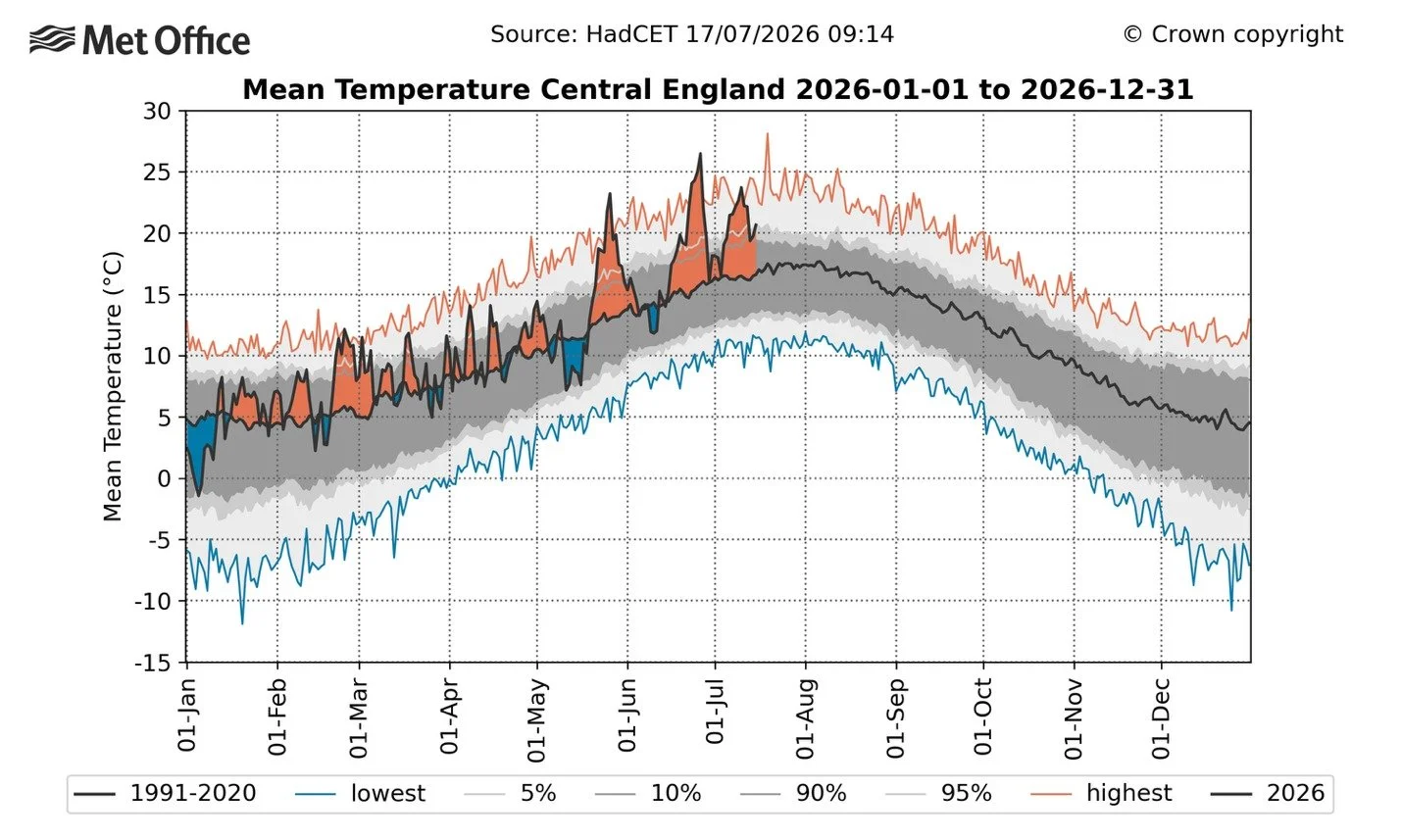
Source: Met Office HadCET, © Crown copyright.
The headline warming figure so often reported, ‘1.5 degrees’, understates the danger. The hottest days, and the warm nights that do most of the health damage, rise faster than the average: the most recent decade is about 1.33°C warmer than 1961–1990, but the hottest day of the year in the south-east has warmed by around 4.5°C (Met Office).
So holding global warming to 2°C, for example, would not mean Brighton and Hove’s summers get two degrees warmer; it would mean the dangerous days and nights get hotter, and more frequent. As the national risk assessment puts it, the UK “is built for a climate that no longer exists today.”
Where heat harms
The headline numbers — 40°C, red alerts, record-breaking days — are what make the news. But most heat harm in Britain happens well below them, and the temperature on a weather forecast is not the temperature people actually live in. Three gaps matter for Brighton and Hove.
Harm begins long before the extremes. Heat-related deaths in England start rising from the low twenties, not at 40°C, and the South East already records the highest heat-mortality rate of any English region (UKHSA). For London, the point at which deaths begin to climb sits at around 19°C (Hajat et al., 2002). By the time an alert is issued, people have already been dying for days.
The air outside is not the air indoors. People spend around 90% of their time indoors (Klepeis et al., 2001), and a home holds and builds heat. A living area is overheating once it passes 28°C, and a bedroom at 26°C, on the CIBSE benchmark (CIBSE). A top-floor flat or a west-facing conversion can sit several degrees above the outdoor reading and, worse, fail to cool overnight, so a “moderate” 28°C day outside can mean a bedroom that never drops below the danger line.
The air is not the street either. What a body feels outdoors is not the air temperature but the Universal Thermal Climate Index (UTCI), which combines air temperature with radiant heat from hot paving and buildings, wind and humidity (Bröde et al., 2012). In a sunlit street the radiant load can push the felt temperature several degrees above the shade reading, so a bus stop can sit in “strong heat stress” of 32-38°C UTCI while the forecast reads 26°C; UK mortality effects begin at around 20°C UTCI (Di Napoli et al., 2018).
Our companion paper’s street-level modelling finds Brighton’s priority hotspots reaching 34-46°C UTCI on days that never trigger a national alert, with the North Street bus stops in the “very strong heat stress” band of 38-46°C (Dunsby, 2026, published alongside this paper). The same paving reaches 50-65°C underfoot in strong sun, hot enough to burn a dog’s paw pads within about a minute (AAHA).
Table 1
What heat thresholds mean for people in Brighton and Hove
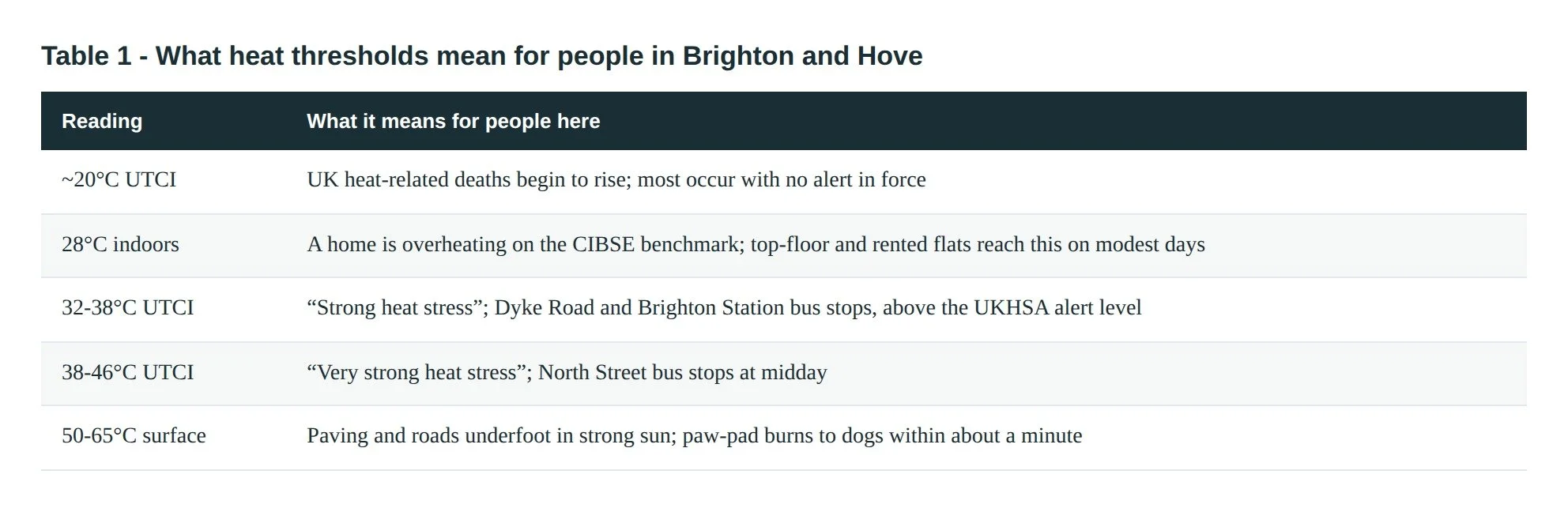
Sources: UKHSA heat-mortality monitoring 2024; Hajat et al. (2002) on the London threshold; CIBSE overheating criteria (Guide A / TM52); Bröde et al. (2012) and Di Napoli et al. (2018) on UTCI; AAHA on pavement surface temperatures; Dunsby (2026).
The point is not that 40°C does not matter, it is that a city which prepares only for 40°C will miss most of the harm.
The reach of heat, and where this paper focuses
Heat touches almost everything. It fills hospital wards and care homes. The CRVA warns that up to 90% of hospital wards could overheat, and UKHSA found that care homes saw the largest proportional rise in heat-associated deaths in 2025. It buckles rail and softens roads, and strains the energy, water and digital networks the CRVA rates as high-risk. It drains productivity from workplaces indoors and out, with no legal maximum working temperature to protect anyone. It degrades mental health, lifting hospital admissions for mental illness by around a tenth during sustained heat, disrupting sleep, and raising suicide risk as temperatures climb (Page, Hajat & Kovats, 2007). It reaches people in transit: buses, the transport lower-income residents most depend on, are largely without air conditioning, so the heaviest exposure often falls on those least able to avoid it. The scale is city-wide, and the economic cost is large: heat-related mortality in England has been valued at around £6.4 billion a year in the 2020s, rising to £13.7 billion by the 2050s (Watkiss et al., 2021).
This paper does not attempt to address all of that. It focuses, deliberately, on the human and social dimension, on who is harmed, where, and how the city, the health system and the community can protect them, using the public-realm, planning, housing and public-health levers the city holds, some fully and some only in part. The engineering resilience of the energy, water and transport networks themselves is acknowledged but largely out of scope.
That boundary is a choice of focus, not a claim that the rest matters less; the wider adaptation picture, flooding, water, nature and infrastructure, is taken up in a companion Climate:Change piece, The Climate Change Committee’s A Well-Adapted UK report: implications for Brighton and Hove. Where the city can shape the public realm and public transport (such as shaded, cooler bus shelters, and pressing bus operators to run cooler vehicles, which it can influence but not compel) stays in scope, not least because heat on the bus network is an equity issue as much as an engineering one.
Where heat bites, and on whom
On a summer day in Brighton and Hove, on an afternoon that feels pleasant, an older person is sitting in a room that has quietly passed 28°C, still in a jumper, feeling fine and not being fine. That is where the risk mostly lives, indoors, unseen, among the people least able to act.
The city can be specific about where. The CRVA rates health-and-wellbeing risk from high temperatures (its risk code H1) “High” now, rising to the top of its scale by the 2080s. The heat-island map concentrates heat in the city centre, Hanover, Lansdowne Place and the Dyke Road-Station corridor, a surface uplift reaching 7.7°C, with the Royal Sussex County Hospital in a high-heat zone. The CRVA names the buildings most at risk, up to 90% of hospital wards could overheat (H12), and an Arup study for the Greater London Authority, which the CRVA cites, found that 78% of 60 London schools surveyed had already experienced overheating in the summer term (H13; cited in Heat Ready London, 2026); Brighton’s own schools sit broadly outside the city’s hottest areas, though some, such as Elm Grove Primary, fall within them, and the deprived neighbourhoods where heat and disadvantage compound: central Brighton, the corridor from Stanmer through Bevendean to Whitehawk, and Woodingdean.
A sunlit street runs far hotter than the air. Hannah Dunsby’s modelling, summarised for Climate:Change, maps this at one-metre resolution for the city centre: at the midday peak of 19 July 2022, no cool refuge existed anywhere in the mapped square kilometre, felt temperatures varied by 6°C over distances under 100 metres, and the whole area stayed above the mortality threshold overnight.
What turns exposure into harm is circumstance. The national evidence is clear on who is most at risk (Hajat, Kovats & Lachowycz, 2007) and which homes overheat most, top-floor, single-aspect and post-1990 flats, and poorer rented stock (Beizaee et al., 2013; Buildings & Cities, 2021). Care-home residents (particularly women) are among the most at risk of all, given age, frailty and buildings that overheat. And it is duration as much as peak temperature that does the damage: someone who can step indoors into a cooler or cooled space is exposed for minutes, while a person waiting for a bus, sleeping rough or working an outdoor shift is exposed for hours, and it is cumulative exposure, not the peak reading, that best predicts who dies (Gasparrini et al., 2015).
Brighton’s profile sharpens it:
Table 2
Who is most exposed to heat in Brighton and Hove, and why
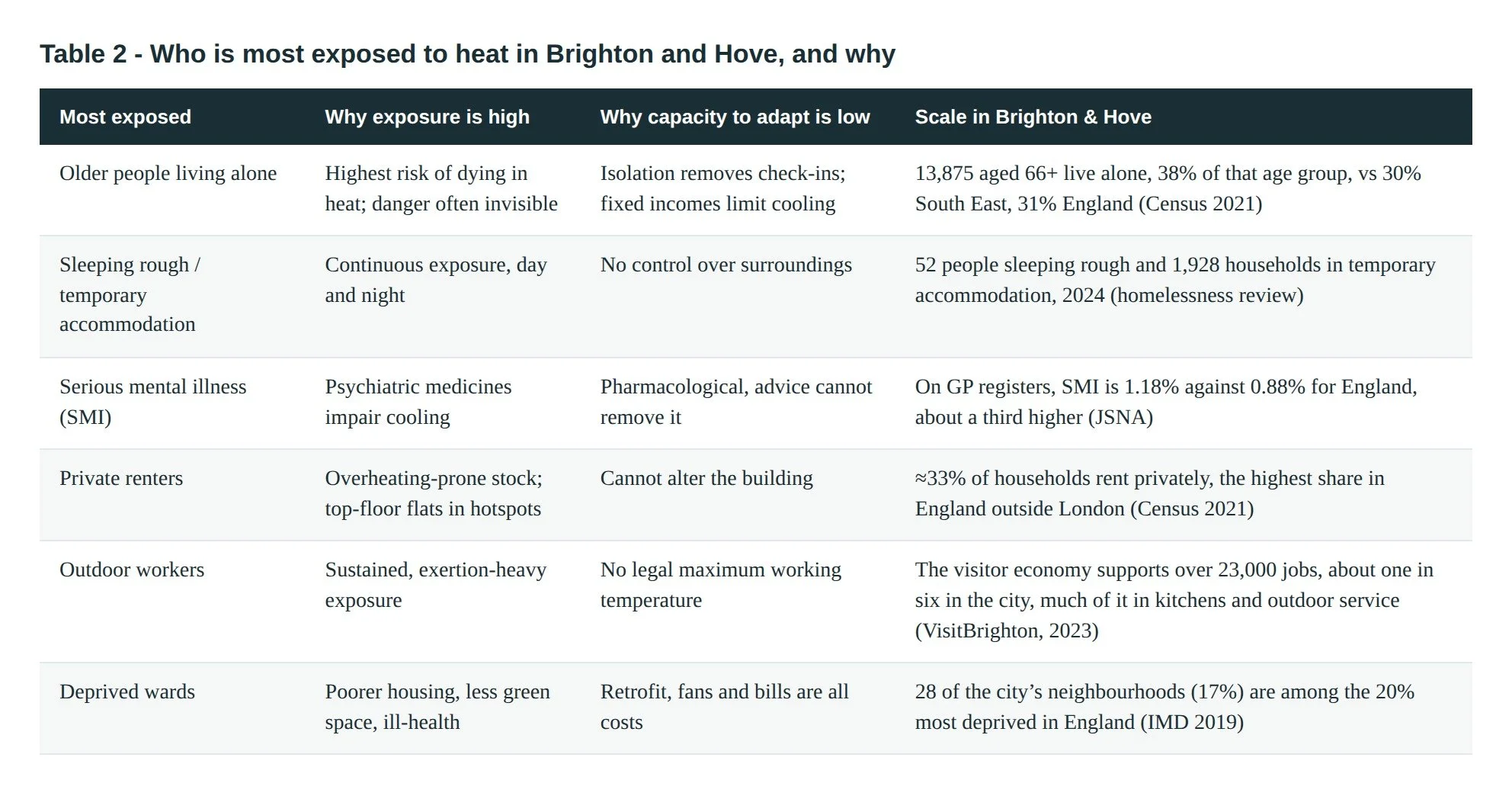
Sources: Brighton & Hove Climate and Nature Action Plan 2026 and CRVA (Arup, 2023); Climate Change Committee, A Well-Adapted UK; the combined authority’s functions per the Planning and Infrastructure Act 2025. Census 2021; IMD 2019; Brighton & Hove homelessness review 2025; Brighton & Hove mental health JSNA; VisitBrighton (2023); Hajat, Kovats & Lachowycz (2007). Levers and constraints are Climate:Change’s reading of published roles and powers.
These exposures to heat harm overlap: the older private renter on cardiac medication, alone in a top-floor Hanover conversion, carries every factor at once. A silent hazard - and silent hazards fall between institutional responsibilities.
Active, but not yet resourced
Brighton is not a city doing nothing: a top climate-leadership grade (CDP A), a 133-action plan with adaptation drawn from the CRVA, a Cabinet lead, and cool spaces and water fillers during alerts, and a £1.3 million Climate for Communities project working with high-need neighbourhoods such as Moulsecoomb. And on the evidence it is well ahead of most: a July 2026 review of English local plans found only 11% are informed by a climate vulnerability or risk assessment (RTPI/TCPA), where Brighton holds a full CRVA and an urban heat island map, with Hannah Dunsby’s street-level modelling, summarised for Climate:Change, adding to it. A serious, evidence-led start.
But activity is not sufficiency - Brighton’s gap is the same as the national one. The same review of English local plans found “a stark gap between stated climate ambition and tangible policy action” across the country: high-level objectives rarely backed by funded, evidenced policy. Locally that shows up precisely: heat is treated as a strand inside larger, medium-term programmes rather than a specifically resourced priority. Overheating sits within a blue-green infrastructure (parks, trees and water) “implementation and investment plan” scheduled for the medium term, a real trade-off, since folding heat into a bigger, potentially funded programme can resource an issue with no statutory duty of its own, but risks diluting the focus until heat is one consideration among many. Either way, the plan attaches no cost or funding to its heat actions, sets no measurable target or trigger, and still lists the adaptation lead as to be established, though substantial adaptation work continues under the Climate and Nature Action Plan without one. It concedes the work “will require the development and costing of new projects and programmes” (CNAP, 2026). A companion analysis by Andrew Coleman for Climate:Change analysis set out a fuller review of the city’s adaptation planning (Coleman, 2024).
The national pattern the CCC describes is that climate roles without a statutory duty are thin everywhere. And heat is not the Council’s alone, “everyone has a role to play.” The table maps who holds which lever.
Table 3
Who holds which lever on heat
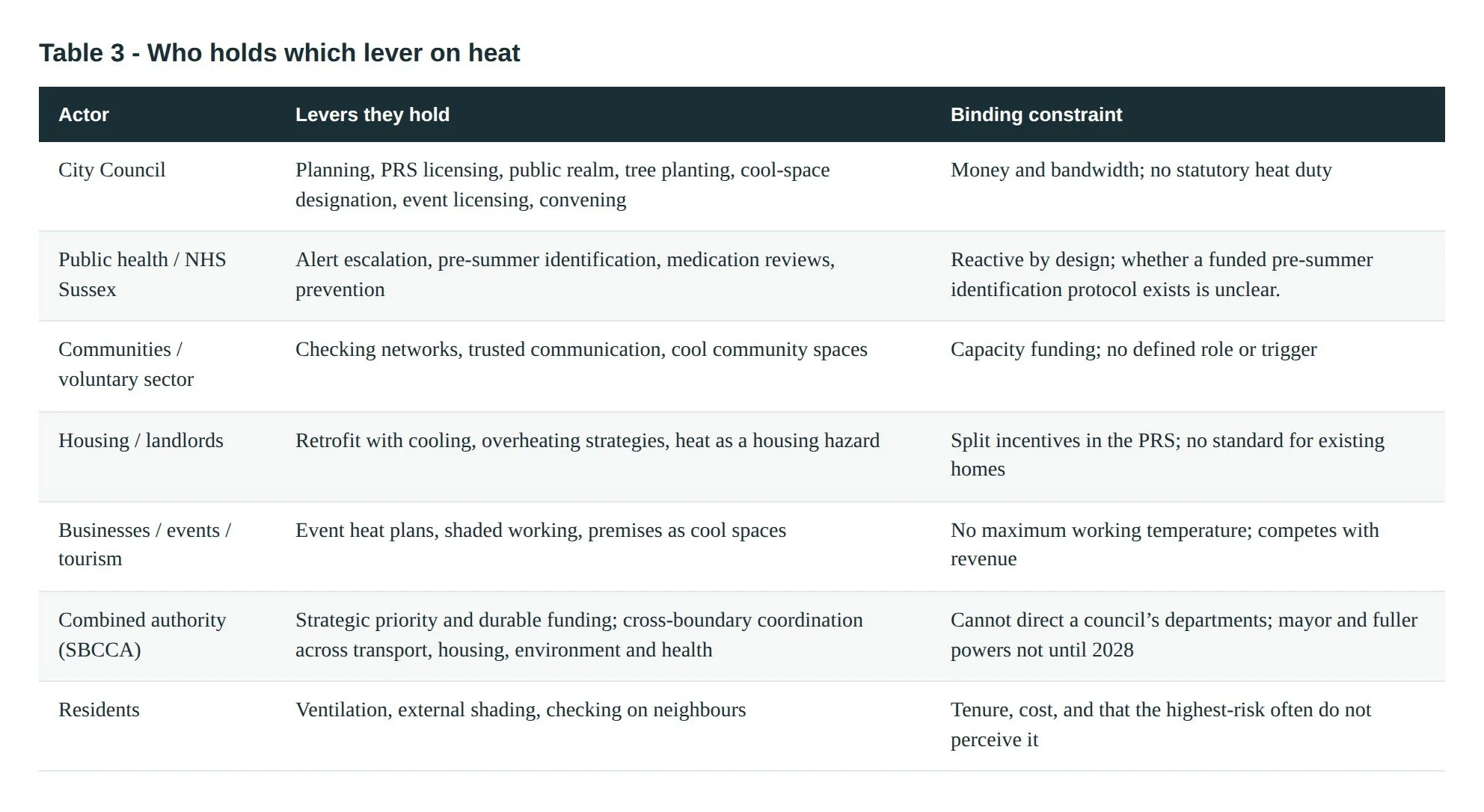
Sources: WHO Europe, Heat–Health Action Plans guidance, 2nd edition (2026), eight core elements; Brighton’s position assessed by Climate:Change against the city’s CRVA, Climate and Nature Action Plan 2026 and hot-weather response.
One recent step shows both the progress and what remains. The Council’s cool spaces map is now live — a public interactive map that layers cool spaces with water points, parks and gardens and tree-cover data across the city’s wards — alongside a year-round “Places to stay cool in Brighton & Hove” page and a “Warm welcome directory” of indoor places to go. As standing web resources these are available year-round, not only when an alert is in force, so the open questions now are promotion — whether residents are pointed to them in ordinary warm weather, not only during red or amber alerts — and reach, since some cool spaces are known to the Council only for specific heat events. Some venues, libraries and shopping centres among them, are cool year-round regardless though travel to them of course can affect those most vulnerable.
Following the city’s hottest June day on record, councillors backed a motion for the Council to review whether its plan adequately addresses extreme heat, and to convene a Heatwave Partnership bringing together the Council, NHS, schools, universities, housing providers, emergency services and community organisations. The motion also pressed for heat to be built further into strategy and planning, for cooling in care homes and schools, and for the Government to legislate a maximum working temperature (Brighton and Hove News).
This is the type of machinery this paper calls for. Its contribution now is to set the standard those efforts can aim at — what good looks like for the review, and the work a partnership should take on. The scope and timescale of the review are not yet defined, and nor are the form, timescale and funding of the partnership; the paper’s case is that the review should be comprehensive, reaching the ordinary warm days that carry most of the risk and the social and health dimension, not buildings and greening alone, while recognising that the more comprehensive the review, the more resource it needs. The recommendations that follow are offered as evidence-based inputs to both.
Addressing the non-statutory issue for heat
Local heat work is fragile: it is nobody’s statutory duty, it is unfunded, and it is among the first things cut when budgets tighten. There is now a possible answer. The Sussex & Brighton Combined County Authority was set up in 2026 and covers Brighton & Hove, East Sussex and West Sussex. For now it runs in interim form, chaired by the three councils in turn until a mayor is elected in May 2028. It has an investment fund of £1.14 billion, but that is spread over thirty years, and only around £30 million of it is available before the mayor arrives. Its remit covers transport, housing, environment and climate, and health — the areas heat runs across — so it could do what a single council cannot: make adaptation a stated priority its members have to deliver, and hold funding for it beyond a single budget round. The near-term money, though, is small and not yet committed, so a lasting settlement for heat is something the authority would have to choose, not a pot it can draw on today.
One of its powers is properly statutory, and it is the one that matters most here. Under the Planning and Infrastructure Act 2025 the authority is required to produce a Spatial Development Strategy, and Sussex & Brighton is among the areas identified to prepare one. Once that strategy is adopted, the three areas’ local plans have to conform to it, and preparing it falls to the strategic authority rather than waiting on the elected mayor due in 2028. The strategy has to cover strategic land use, housing and infrastructure. Whether it also carries standards on overheating and green infrastructure is a choice, but a realistic one: London’s plan is a spatial development strategy of the same kind and already sets a cooling hierarchy that boroughs must follow (London Plan, Policy SI4), and Greater Manchester has brought flood and heat risk together at the same scale. So the route exists to write heat and green-infrastructure standards into a Sussex-wide plan, which no single district could do on its own.
So “good” here works at two levels: the council using the powers it already has, and the authority adding the strategic priority, the planning framework and, in time, the funding a single budget cannot secure. Three things qualify it. Heat has to make the authority’s early priorities. The mayor, the fuller planning powers and most of the money arrive only from 2028. And the authority is Sussex-wide, while this paper’s evidence is specific to the city, so heat in the rural and coastal parts would need its own evidence. The Council itself expects the authority to be well placed to take a strategic, Sussex-wide view of adaptation.
What “good” looks like, and how Brighton measures up
There is a growing body of evidence for us to draw on when looking at what ‘good’ looks like.
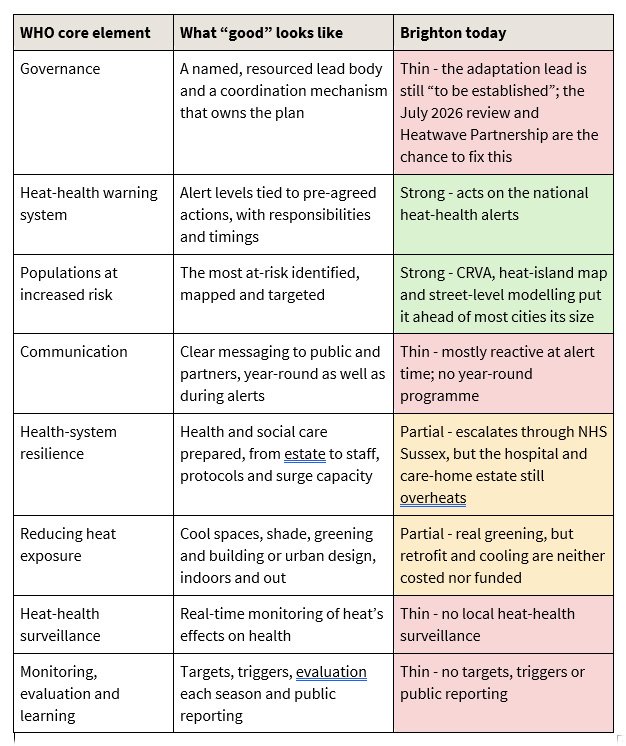
The national bar is set. The Climate Change Committee’s A Well-Adapted UK gives the objective: no increase in heat-related mortality, holding excess heat deaths in 2050 to no more than today’s (against 1,400-3,000 a year now, and potentially 3,000-10,000 by 2050 without action). It also makes the economic case: cooling is the single largest share, around a third, of the adaptation investment the UK needs, and heat measures are among the higher-value actions, with the CCRA3 cost–benefit analysis putting the benefit–cost ratio for heat-alert and heatwave planning above 10:1 (CCRA3, in UKHSA evidence, 2023) — though a single ratio turns on its assumptions and does not transfer directly between places, so it is best read as an order of magnitude, not a Brighton figure. Adaptation is an investment, not only a cost. Alongside it, the WHO’s eight core elements, updated in June 2026, give the operational checklist a good plan should meet (see the figure of the WHO’s eight core elements, and Table 4).
Leading cities show what it looks like on the ground
London’s first heat plan (June 2026) makes three points Brighton can act on directly: a plan turns analysis into someone’s job, with a single framework, a named owner and commitments partners can be held to; schools and shade are ready-made entry points, through 60 bespoke Climate Resilient Schools plans; and cool spaces only help the people who reach them, so London pairs its map with outreach, following the evidence from Chicago in 1995 and Paris after 2003 that proactive contact saves lives.
Athens and Miami go a step further with Chief Heat Officers (Atlantic Council), where the lesson is not the job title but that heat becomes deliverable when it is visibly someone’s job.
Beyond the UK the pattern repeats: Barcelona’s Superblocks are modelled to cut the urban heat island and, with cleaner air and quieter streets, to prevent hundreds of premature deaths a year (Mueller et al., 2020); and in Valencia a shade-led package of overhead structures, cool surfaces and street greening is modelled to cut felt temperature by up to 6.3°C, with shade doing most of the work (de Sola Caraballo et al., 2024).
How to cool matters as much as whether to. The cooling hierarchy, from the UK Green Building Council and Parliament’s Environmental Audit Committee, puts passive design first (shading, orientation, glazing and green roofs), then natural cooling and fans, with air conditioning last (see the cooling-hierarchy figure), because an air-conditioning-led response raises bills and emissions and widens the gap (IEA, 2018). It can also contribute to the urban heat island effect with expelled hot air further heating the street outside. Only about 9% of English local plans yet require a cooling-hierarchy approach, and even those requiring any cooling or ventilation strategy are a minority (RTPI/TCPA, 2026), so adopting the hierarchy would put Brighton among the leaders. Shade the UK offers a practical frame, treating shade as public-health infrastructure, and its home guide finds external shading the most effective single step, with low-cost options for those least able to adapt. The order matters for public-realm measures too: shade and canopy give the largest and most permanent cut in heat stress and should come first; drinking water addresses dehydration but not the heat itself; and misting works only in dry, breezy conditions, so it is a poor substitute for shade on Brighton’s humid coast.
Figure 2
The cooling hierarchy
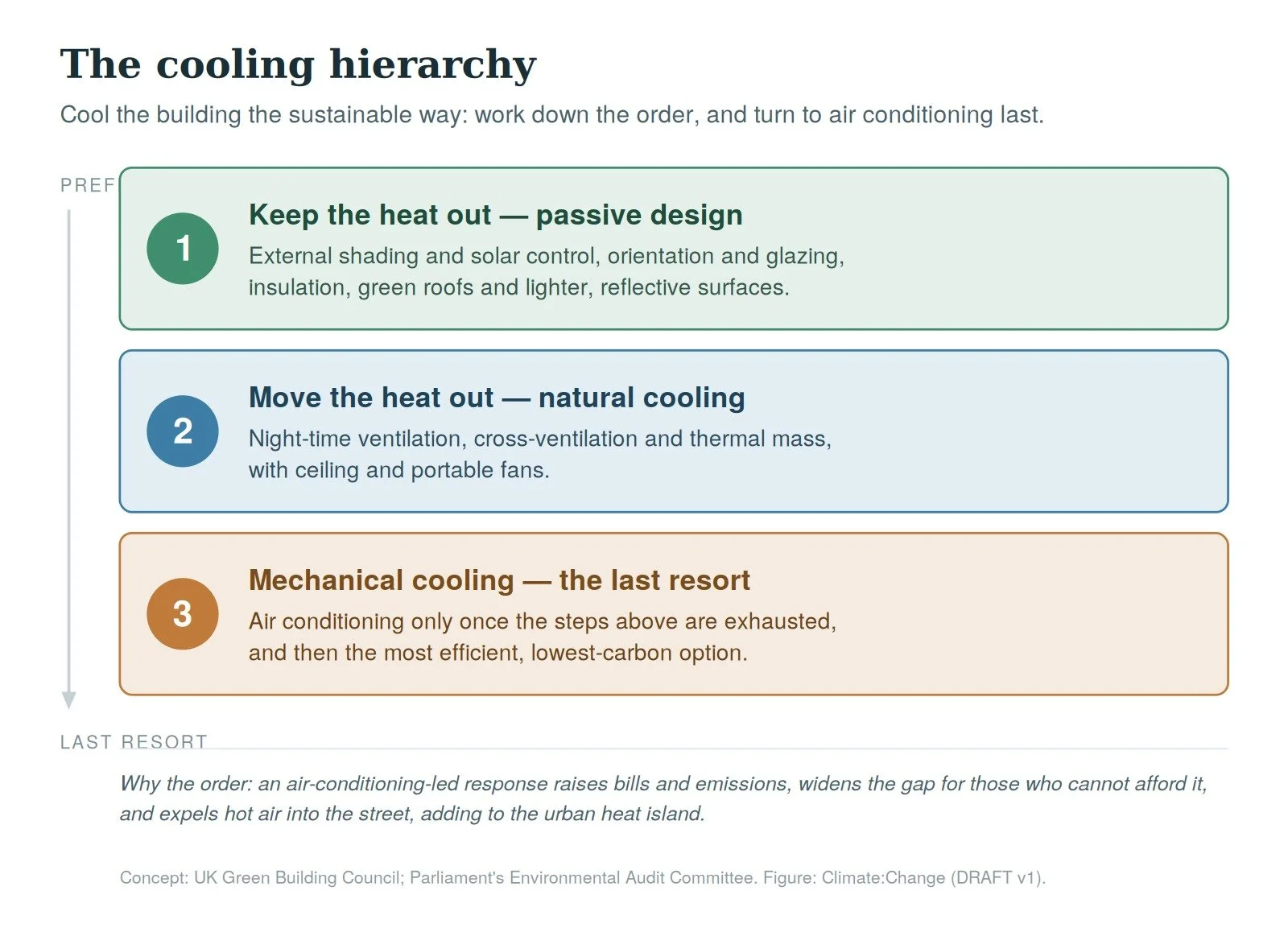
Concept: UK Green Building Council; Environmental Audit Committee.
And the moment to act is now. A National Heat Risk Commission, based at the LSE and chaired by the former Environment Agency chair Emma Howard Boyd, was created in 2026 and publishes its final report in June 2027, and it has asked for local heat-resilience work to be surfaced. The step this points to is immediate and low-cost: put Brighton and Hove’s evidence and case to the Commission now, as a contribution to its 2027 report. A city with this evidence base is exactly what the Commission is asking to see.
Measured against the WHO checklist, Brighton’s position is fair: strong on two elements, doing real but unfunded work on two more, and thin on the remaining four. The four thin ones are exactly what a heat plan review and the Heatwave Partnership could put right.
Figure 3
The WHO's eight core elements, and where Brighton stands
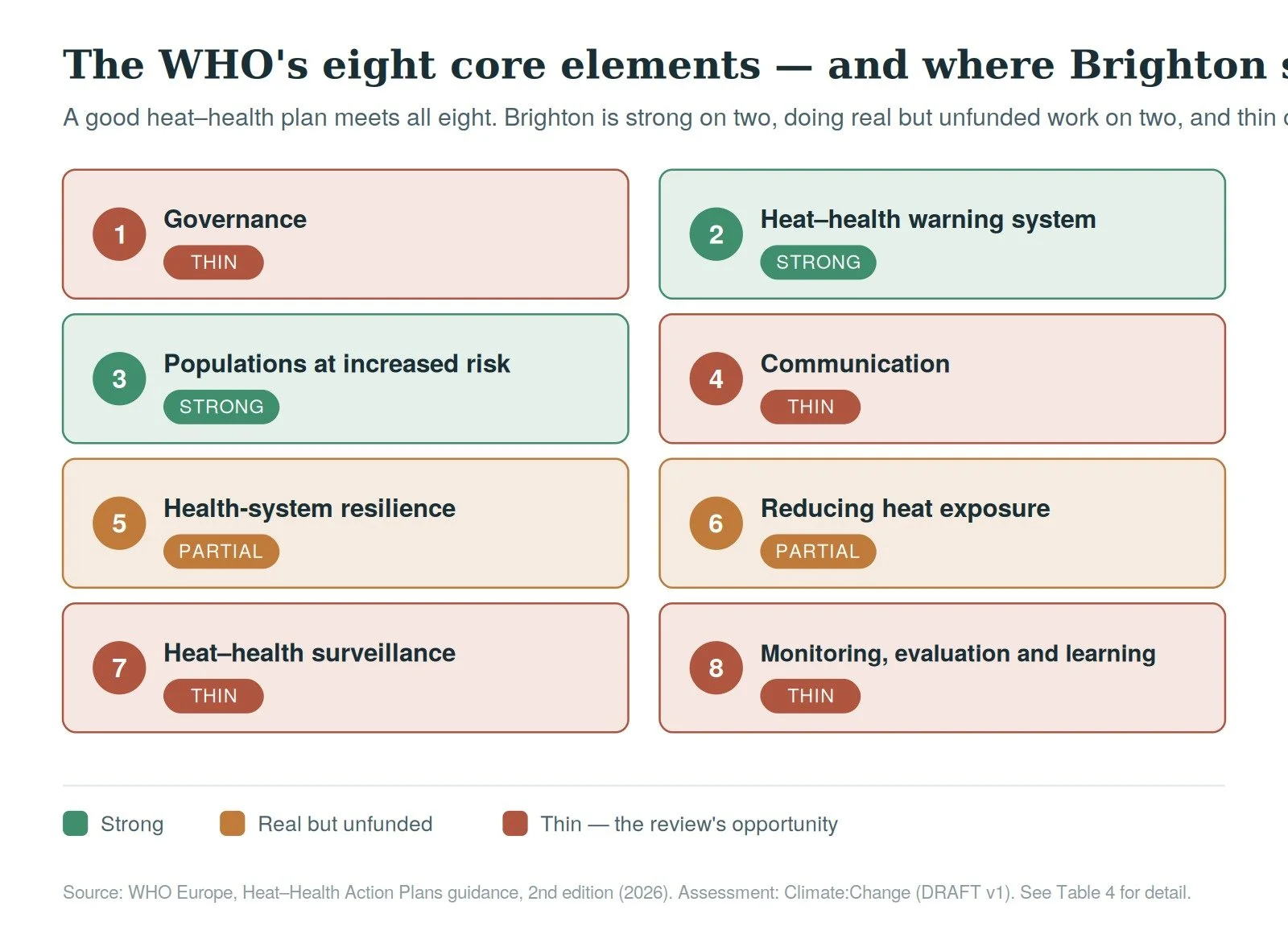
Source: WHO Europe (2026); assessment: Climate:Change.
Table 4
Brighton and Hove against the WHO heat-health action plan 2026 checklist
Conclusion
Summer 2026 will be remembered for its headlines. The sharper lesson for Brighton and Hove is in the ordinary summers, where the harm already falls, on the days the forecast calls pleasant. Summer 2025 showed the other half: where a system is in place, fewer people die.
The city has made a strong start, better evidence than almost any of its size, a serious plan, Cabinet leadership, and, in July 2026, a commitment to review its heat response and a new Heatwave Partnership.
What is not yet in place is the funding and the durable mandate to match the evidence, and the same is true nationally, where adaptation still carries no statutory duty. Brighton now has both a clear picture of what good looks like, from the WHO, the CCC, London and cities beyond, and, in the combined authority and the National Heat Risk Commission, the machinery to make a response durable and to be heard nationally.
Recommendations: strengthening the response
Most of what would strengthen the response builds on what is begun, and reaches the specific places and people Sections 1 and 2 identify. Several map directly onto the heat-plan review the Council has been pressed for and the Heatwave Partnership it has announced, and are offered as inputs to both. This is a task for the whole city, not the Council alone, so each names who would lead. They are organised to close the four WHO elements Brighton is thin on — governance, communication, heat-health surveillance, and monitoring and evaluation — as well as to build on its strengths.
Build the summer equivalent of the winter machinery (NHS Sussex, public health and the voluntary sector, with the Council convening), confirm, and if needed establish and fund, pre-summer identification of the highest-risk residents, a checking protocol and medication reviews (the Council’s current arrangements across housing, adult social care, public health and families would need confirming). Whether someone knocks on the door is what changed survival in Chicago (Semenza et al., 1996; Klinenberg, 2002).
Make cool space a real, year-round network, built on the newly live map (the Council, with community organisations and willing businesses), libraries, community centres, churches and willing businesses, sited on the heat-island and street-level evidence, activated at moderate temperatures not only alerts, with proactive outreach. [WHO: communication]
Shade the hotspots the city has already mapped (the Council’s planning and highways teams), visible shading at the North Street, Dyke Road and Station bus stops and along the Dyke Road-Station corridor, with planning guidance resolving the heritage-versus-shading tension in a city of Regency facades (Historic England).
Press for cooler buses as transport powers mature (the Council now; the Sussex & Brighton authority from 2028). Buses are the transport lower-income residents most depend on and are largely without air conditioning, so the heaviest exposure falls on those least able to avoid it. Cooler, shaded shelters can come sooner; the authority’s incoming bus powers are the realistic route to cooler vehicles.
Set a net canopy target where heat and people meet (the Council, with the combined authority as a route to the funding). Canopy cover is 10.5%, below the 15% coastal benchmark, and dominated by elm under active dis ease threat; the Council is acting on its June 2023 Treeconomics map, whose priorities coincide with the heat hotspots. But planting is costly and slow and disease losses are eating the canopy, so the goal is a net, disease-resilient canopy, and 15% will take sustained investment. A numerical canopy target would itself be leading practice; few English local plans set one (the RTPI/TCPA 2026 review reports a green-space-factor figure of about 6%; a numerical canopy target would go further).
Pilot Climate Resilient Schools in the heat-island hotspots (the Council and schools), adapting London’s model of bespoke school adaptation plans to Brighton’s H13 risk, cheap, visible, and reaching children in the wards with least green space.
Target the homes that overheat, cooling the right way (the Council on rented stock, landlords and housing associations on the worst homes, and residents on what they can change themselves), focus the Council’s enforcement where it actually reaches, chiefly rented stock: the specific homes the evidence identifies, through private-rented-sector (PRS) licensing and the excess-heat housing hazard, which lets councils act on dangerously hot rented homes, passive-first per the cooling hierarchy (EAC) rather than defaulting to air conditioning.
For the wider stock the Council cannot compel (owner-occupied homes above all), pair enforcement with plain public guidance on what residents can do themselves: external shading first, since blocking the sun before it reaches the glass is the most effective step, then blackout blinds, light curtains and night-time ventilation, with low-cost options for those least able to adapt (Shade the UK). Part O of the Building Regulations, which limits overheating in new homes, still covers new build only. The wider planning position has moved: on 17 August 2026 the Government published its response to the December 2025 consultation and a revised National Planning Policy Framework. The outcome was more permissive than the draft had implied — local plans may now set energy-efficiency standards beyond Building Regulations where these are justified, robustly costed and viability-tested (Plan-making Policy PM13), and the adaptation policy has been broadened to give substantial weight to the resilience of the built environment (Policy CC3). How far this leaves room for local overheating standards specifically is less clear from the published framework. But the direction is towards enabling local action rather than restricting it, which strengthens the case for the city to use these levers now.
Treat heat as a visitor-economy and events risk, with real guidance (businesses, event organisers and the BID, with Council guidance), Black Rock, On The Beach, Pride pack crowds onto hard ground at peak heat, and the CRVA flags the “dominance of summer tourism and event income.” The Council licenses these events, so it holds a lever, the ask is best-practice event heat plans and sustainable-cooling guidance for premises, not ad hoc conditions.
Apply an equity test, and report (the Council, reporting openly to partners and the public), assess every measure against whether it reaches the Section 2 groups, and publish a short annual account, which also answers the monitoring gap. Public support for heat action is strongest when it is tied to specific, visible local improvements and backed by clear accountability and ring-fenced funding. [WHO: monitoring and evaluation]
Use the combined authority to give heat a durable, regional footing (the Sussex & Brighton Strategic Authority, with the Council) [WHO: governance]. A single council’s heat work is fragile and among the first things cut when budgets tighten. Under the Planning and Infrastructure Act 2025 the authority is required to produce a Spatial Development Strategy that local plans have to conform to, and London’s equivalent already sets a cooling hierarchy its boroughs must follow — so a Sussex & Brighton strategy could embed overheating and green-infrastructure standards across the county in one move. The £1.14 billion fund is spread over thirty years, with little available before the mayor arrives in 2028, so a durable funding line for heat is a priority the authority would have to choose. Brighton is well placed to press for this while its leader takes a turn chairing the authority, and the moment to write heat into its early priorities is now.
That is a task for the whole city, and one Brighton and Hove is unusually well placed to lead. The next heatwave will not need to break records to do harm here, but this is a danger the city can see coming, street by street, and get ahead of.
__________
Further references are in a separate document, here.
Nicky Lumb is Co-Chair of Climate:Change
Perspective pieces are the responsibility of the authors, and do not commit Climate:Change in any way. Comments are welcome.