
Book Review. UNEP Emissions Gap Report 2026
Simon Maxwell
The Emissions Gap Report is the annual alarm call from UN Environment that the world is not delivering the commitments needed to limit global warming to the Paris goal – and worse, that it is not living up to the commitments it has already made. This year’s report, published on 21 October, is true to form.
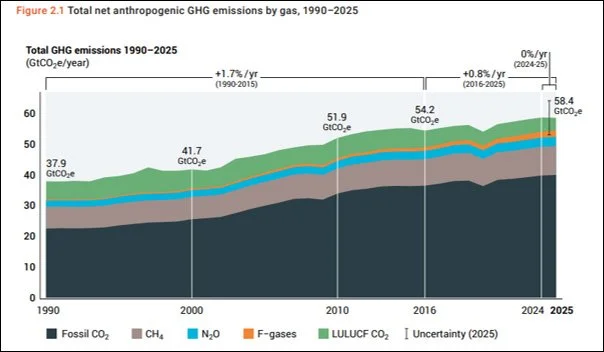
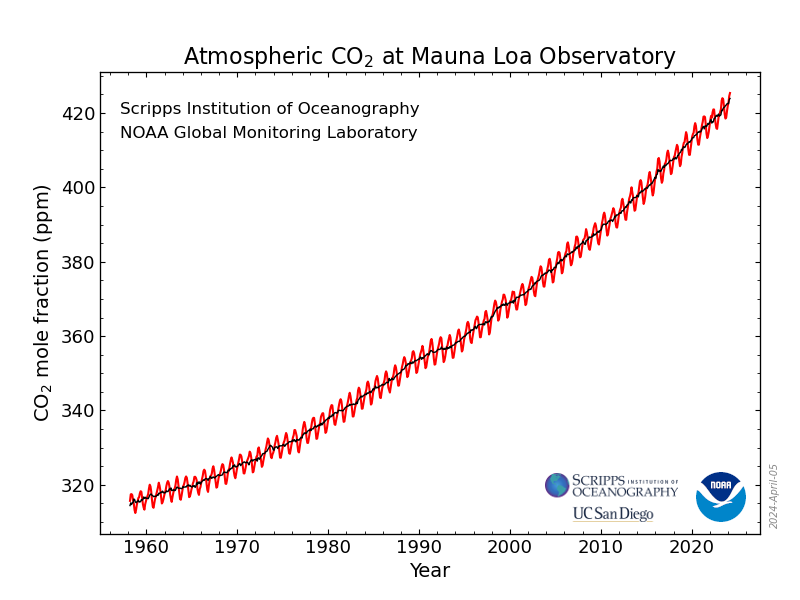
The backdrop is that emissions have risen from 38 GT CO2e in 1990 to 58 Gt in 2025 (Figure 1). The rate of increase is declining, and emissions were actually unchanged in 2025 from a year earlier, so it may be that peaking is in sight. Note, however, that the 2025 figure is an anomaly, because there were fewer forest fires than normal. Further, stopping the increase is not the same as stopping the damage: the tap may not be opening wider, but water is still pouring into the bath. The amount of CO2 in the atmosphere increased from 354 PPM in 1990 to 427 PPM in 2025 - and rose in 2025 compared to 2024. (Figure 2).
Figure 1
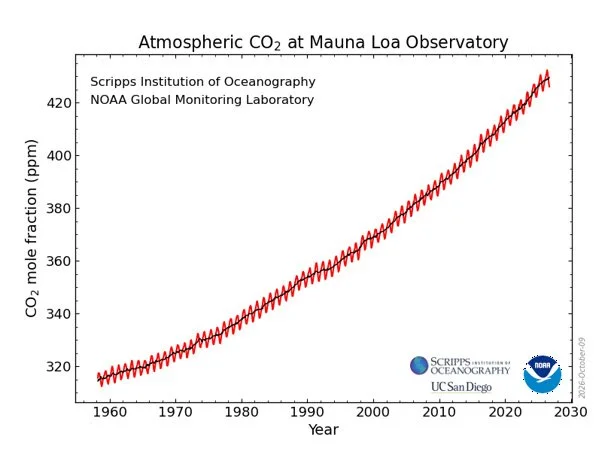
Source: https://gml.noaa.gov/webdata/ccgg/trends/co2_data_mlo.png
The trends mean that limiting warming to 1.5 degrees with no or limited overshoot is now out of reach. This was also the message of another UNEP Report, published in September, ‘Limiting Overshoot. Navigating Exceedence of 1.5 degrees C and Pathways Towards Return’. It is important to understand that the limit is defined as a 20-30 year average, so occasional years of 1.5 do not mean that the limit has officially been breached: 2024 was above 1.5, for example, according to the WMO, with 2025 not far behind, and 2026 presumably to follow . ‘No or limited overshoot’ means exceeding the limit by 0.1 degrees.
What this means is that the focus of EGR has shifted, from avoiding 1.5 to the question of bending the pathway back by the end of the century. There are five steps in the analysis.
Country commitments
First, a review of current commitments to 2030 and 2035 shows that little progress has been made in the past year. Commitments are voluntary pledges under the Paris Agreement, expressed as Nationally Determined Contributions. They are supposed to demonstrate ever-increasing ambition, with the current round focused on 2035. The number lodged with the UNFCCC has doubled in the last year, to 124, covering 76% of global GHG emissions, but EGR concludes that
‘The full implementation of the new (2035) NDCs would reduce expected global emissions in 2035 by 3.5–4 GtCO₂e compared with 2030 NDC levels. . . These estimates remain similar to last year’s, despite the increase in the number of new NDCs.’
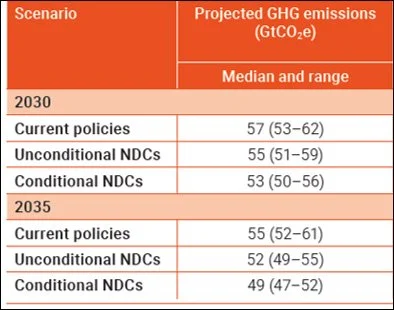
The promised reductions can be seen in Table 1. Under current policies, emissions are expected to fall from 58 Gt in 2025 to 57Gt in 2030 and 55 Gt in 2035, reductions of 1.7% and 5.1% respectively. The best that can be expected if conditional NDCs are delivered is 53 Gt in 2030 and 49 Gt in 2035, reductions of 8.6% and 15.5% - not trivial, but, since these are the numbers for conditional NDCs, dependent on additional financing and technical support for poorer countries.
Table 1
Source: https://wedocs.unep.org/rest/api/core/bitstreams/8819b586-8d60-4aaf-bd0e-4a48d04759f2/content
Progress in delivering commitment: the Implementation Gap
Second, it is important to know that commitments made in NDCs are not yet fully credible given current policies. This is described as the ‘implementation gap’. The global picture is complicated by the withdrawal of the US from the Paris Agreement, and by the fact that some NDCs are so unambitious that the commitment suggested is higher than projected emissions, but overall, EGR says that there has been little progress in aligning policies with 2030 targets. Thus,
‘(There is) a substantial global implementation gap for 2035 . . . indicating limited enhanced collective ambition of 2035 NDCs.’
Greater ambition needed: the Emissions Gap
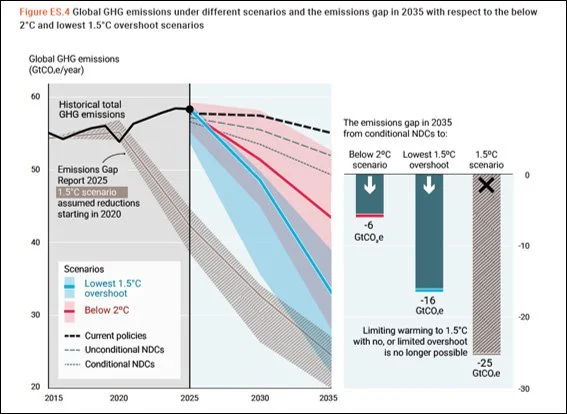
Third, the emissions gap can be derived from the difference between current commitments in NDCs and the emissions required under least cost pathways to either 2 degrees or, eventually, returning to 1.5. This is in Figure 3. Taking the most ambitious , conditional, NDCs as the base, the gap amounts to 6 Gt in 2035 for 2 degrees, and 16 Gt for the lowest overshoot to 1.5. This about doubles the effort already promised to reach 2 degrees and greatly increases the effort required for 1.5: ‘(Countries) must collectively reduce their emissions by an average annual rate of 5.7 per cent between 2025 and 2035.’ Or, to put it another way,
‘To get onto (the 1.5) pathway, global greenhouse gas (GHG) emissions would have to be cut by 18 per cent by 2030, 45 per cent by 2035 and 69 per cent by 2040, relative to 2025 levels.’
Figure 3
Source: https://wedocs.unep.org/rest/api/core/bitstreams/8819b586-8d60-4aaf-bd0e-4a48d04759f2/content
It is worth noting that the 1.5 pathway to 2100 involves a large amount of carbon dioxide removal (CDR), via traditional methods like tree planting or newer methods like carbon capture and storage:
'In addition to higher peak warming, the lowest 1.5°C overshoot scenario creates a need for aggregate CO2 removal from the atmosphere and its permanent sequestration of roughly 320 GtCO2 over the course of this century in order to return warming to 1.5°C by 2100. Our ability to remove such large amounts of CO2 from the atmosphere is uncertain, because of socioeconomic and technological challenges to the scale-up of CO2 removal measures and technologies.'
That is quite an ask. The issue was reviewed in the 2023 Gap report. Currently conventional CDR removes about 2 Gt p.a. and non-conventional 2.3 megatons p.a. The recent exceedance report called for more to be done on CDR, but also commented that:
‘It would take over 100 years of afforestation and forest management at the current scale, and zero residual CO2 emissions, to bring warming back by 0.1°C. Meanwhile, the temperature reduction achievable through novel CDR that relies on geological carbon storage is also constrained. Just maintaining net-zero CO₂ emissions could exhaust current estimated storage capacity in sedimentary basins by 2200.’
Temperature implications
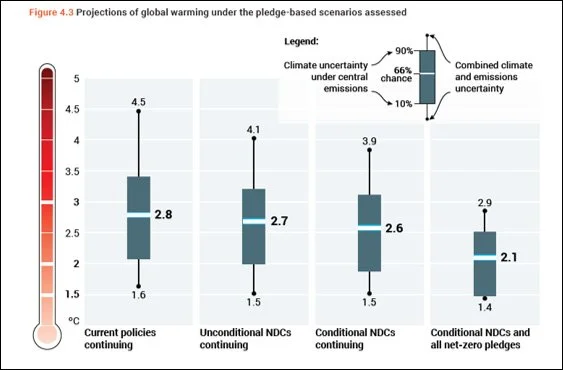
Fourth, the shortfall in pledges implies temperatures that exceed the Paris target. Figure 4 shows that following only current policies would lead to a temperature rise of 2.8 degrees with 66% probability. Delivering the cuts promised in current NDCs reduces the number somewhat, and if long term net zero pledges, still on paper, are included, the figure falls to 2.1 degrees, close to the Paris target.
Figure 4
Source: https://wedocs.unep.org/rest/api/core/bitstreams/8819b586-8d60-4aaf-bd0e-4a48d04759f2/content
Policies that work
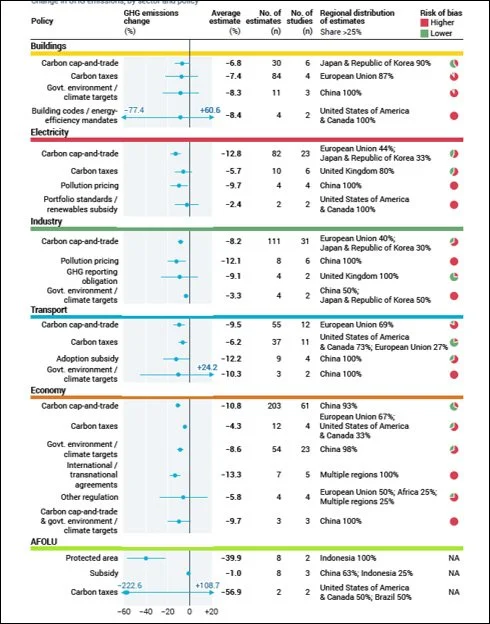
Finally, the challenge is to find policies that work, and see them implemented. EGR has a good stab at this, reviewing 69 cases where emissions fell rapidly, most as a result of policy change (Figure 5). There is emphasis in the analysis on the need for implementation to be managed carefully and programmatically:
‘Well-designed policy packages can enhance effectiveness, but adding instruments indiscriminately may create overlaps that reduce it . . . (and) effectiveness may also depend on how policies are combined, sequenced and implemented’
Figure 5
Source: https://wedocs.unep.org/rest/api/core/bitstreams/8819b586-8d60-4aaf-bd0e-4a48d04759f2/content
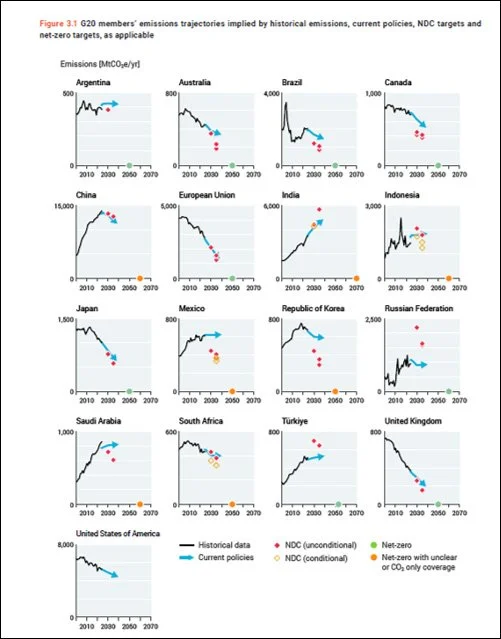
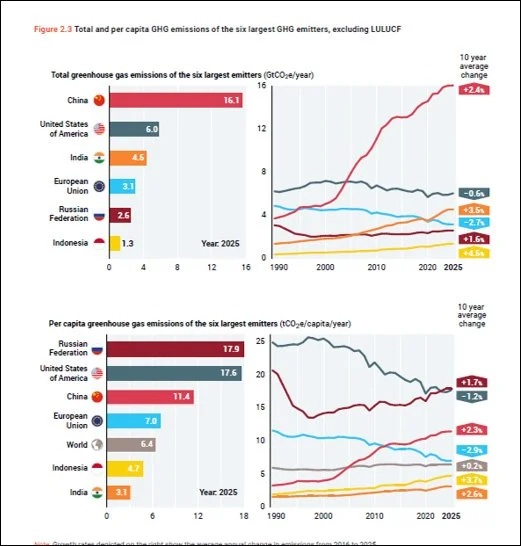
A final point to make is that country performance and prospects of course differ markedly. Some (the UK is one) are on track to net zero. Others are not (Figure 6). Debates about the level of ambition and the allocation of the remaining carbon budget can be left for another day. However, the global picture is changing rapidly as countries grow and the geography of manufacturing changes (Figure 7): per capita emissions in China, for example, now exceed those of the EU. It is also important to say that these data refer to territorial emissions, not consumption emissions. It is a weakness of the UN process that it does not take imported or exported emissions into account.
Figure 6
Source: https://wedocs.unep.org/rest/api/core/bitstreams/8819b586-8d60-4aaf-bd0e-4a48d04759f2/content
______________
Simon Maxwell is Co-Chair of Climate:Change. He was previously on the Steering Committee of the Emissions Gap Report, and in 2022 one of the Chief Scientific Editors.
Perspective pieces are the responsibility of the authors, and do not commit Climate:Change in any way. Comments are welcome.